Menu
- Comment ça marche
- Partenaires
- Assistance
- Blog
- À propos
- Nous contacter
Changer de langue:
Identifiant de transaction
Suivi de l'échange
Tips
12 octobre 2026
Bitcoin Halving Explained: What It Is and Why It Matters
Sommaire
Bitcoin stops at 21 million coins. That number is locked into the protocol and can’t be changed without near-unanimous agreement across the entire network — something that has never happened. The way that limit gets enforced is through halving: a scheduled, periodic cut to the reward miners earn for adding new blocks.
Understanding how that mechanism actually works, and why it matters beyond just the supply cap, starts with what a halving is in the first place.
What Is Bitcoin Halving?
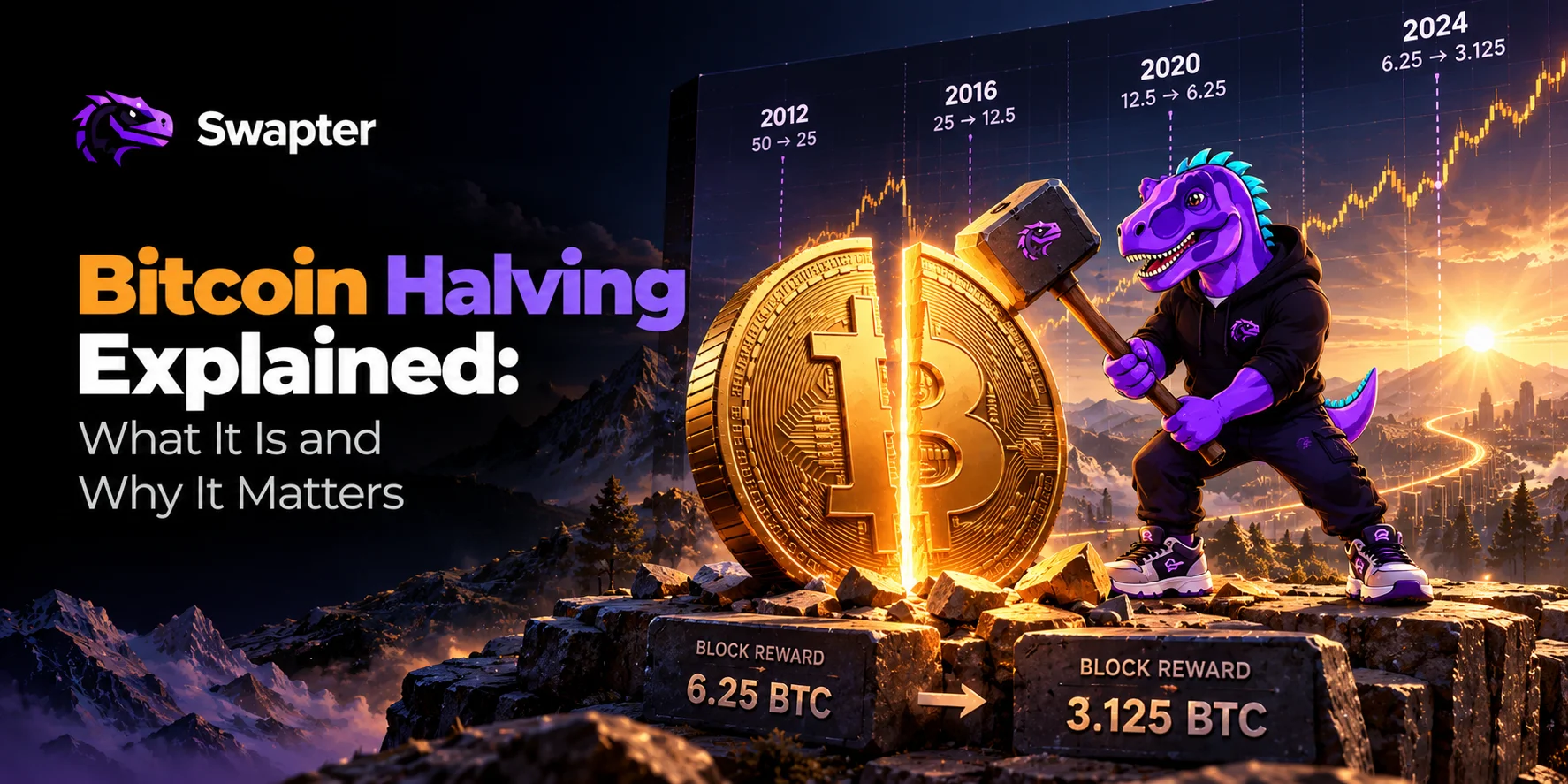
A miner who cracks a valid block gets two things: the block subsidy and whatever fees people paid to get their transactions included. Back in 2009 that subsidy kicked off at 50 BTC. Then it got cut in half, and again, and again. Now you’re looking at 3.125 BTC every time a new block lands.
There’s no slow taper and no committee voting on it. The moment the chain hits a specific block height, the reward just drops. From that point forward every new block carries the smaller number. That’s the whole halving idea in plain English.
The people who built this wanted two things. They wanted a schedule anyone could check and nobody could mess with. And they wanted a hard stop at 21 million coins total. Sometime around 2140 the last subsidy will be gone. After that miners live purely on the fees users decide to attach.
That steady choke on new supply is what makes Bitcoin different from regular money. Central banks can print more whenever they feel like it. Here the code itself locks the issuance in place, and changing it would take near-unanimous agreement across the whole network. Every few years the next cut arrives and people watch what happens to the price, but the mechanism underneath stays exactly the same: fewer new coins, same hard ceiling, until one day the flow hits zero.
How the Halving Cycle Works
Bitcoin doesn’t care about the calendar when it comes to halvings. Everything is measured in blocks. You hit 210,000 and the reward is cut in half. That’s the rule.
The network aims for a new block roughly every ten minutes. Put 210,000 of them back to back and you usually end up somewhere around four years later. Not exact, just close.
Mining power swings up and down all the time. Difficulty adjusts automatically so the average stays near ten minutes. Because of that the actual date on the calendar can shift a few weeks either way. The height-based rule never changes.
Each block still pays out 3.125 BTC right now. Add it up and you’re getting about 450 new coins every day. The next cut will drop that daily number to around 225. This is why the Bitcoin halving schedule gets so much attention: the flow of new coins keeps getting slower over time.
Bitcoin Halving Dates: Past and Next
Four halvings have already taken place. Here’s the full list:
| Halving | Date | Block Height | Reward Before | Reward After |
|---|---|---|---|---|
| 1st | 28 November 2012 | 210,000 | 50 BTC | 25 BTC |
| 2nd | 9 July 2016 | 420,000 | 25 BTC | 12.5 BTC |
| 3rd | 11 May 2020 | 630,000 | 12.5 BTC | 6.25 BTC |
| 4th | 20 April 2024 | 840,000 | 6.25 BTC | 3.125 BTC |
| 5th | ~April 2028 | 1,050,000 | 3.125 BTC | 1.5625 BTC |
Last one happened on 20 April 2024. That’s when the reward dropped to 3.125 BTC. Next cut is locked to block 1,050,000. Most estimates put it somewhere in April 2028, but the exact day can still move a bit depending on block speed.
The Bitcoin halving dates history is based on block numbers rather than fixed calendar dates. The dates after the first few aren’t set in stone beyond the block numbers. Open any block explorer, check the current height, and you can count the remaining blocks yourself.
How Bitcoin Halving Has Affected Price Historically
Looking back at earlier cycles, it is useful to ask when was the last Bitcoin halving. The price often climbed in the months after a cut, although the size and timing of those moves differed each time.
After the 2012 reduction Bitcoin went from around $12 to nearly $1,000 in less than a year. The 2016 cut was followed by a long upward run that eventually got close to $20,000. When the 2020 one arrived, the market later pushed past $60,000. The latest cut in 2024 took place while Bitcoin was trading in the $64,000-$65,000 range. Later in 2025 the price went on to print fresh highs above $100,000.
Of course the price never moves because of one single factor. Liquidity conditions, the broader economy and shifts in demand all leave their mark. Even so, a lot of people still keep an eye on the gradual drop in new supply when they look at the longer-term charts.
There’s a separate article that digs into how price has behaved across the different cycles if you want the wider picture: Bitcoin Price Prediction: Analysis and Forecast.
What Happens After a Halving?
The reward falls and daily issuance drops by half. Miners with higher costs may switch machines off. Hash rate can ease for a while until the remaining players adapt or until the price of BTC rises enough to restore margins.
In the months that follow, the lower supply growth meets the demand that exists at that moment. Previous cycles often recorded a return of interest from both individual and larger buyers during this period. The network itself keeps running without pause. Only the size of the subsidy changes.
Fees gradually form a bigger share of miner income. Each future cut will push that shift further. Long-term security of the chain will rest more on the fees users choose to pay.
Anyone looking for practical steps on the purchase side can read How to Buy Bitcoin.
FAQ
When is the next Bitcoin halving?
How many Bitcoin halvings have there been?
Does halving guarantee a price increase?
What happens to miners after a halving?
When will the last Bitcoin be mined?

Inscrivez-vous à notre newsletter
Rejoignez notre newsletter et restez informé des dernières actualités.

© 2026 Swapter
Tous droits réservés