Идентификатор транзакции
Отслеживание обмена
Tips
16 октября 2026 г.
What Is Bitcoin — Comprehensive Guide
Содержание
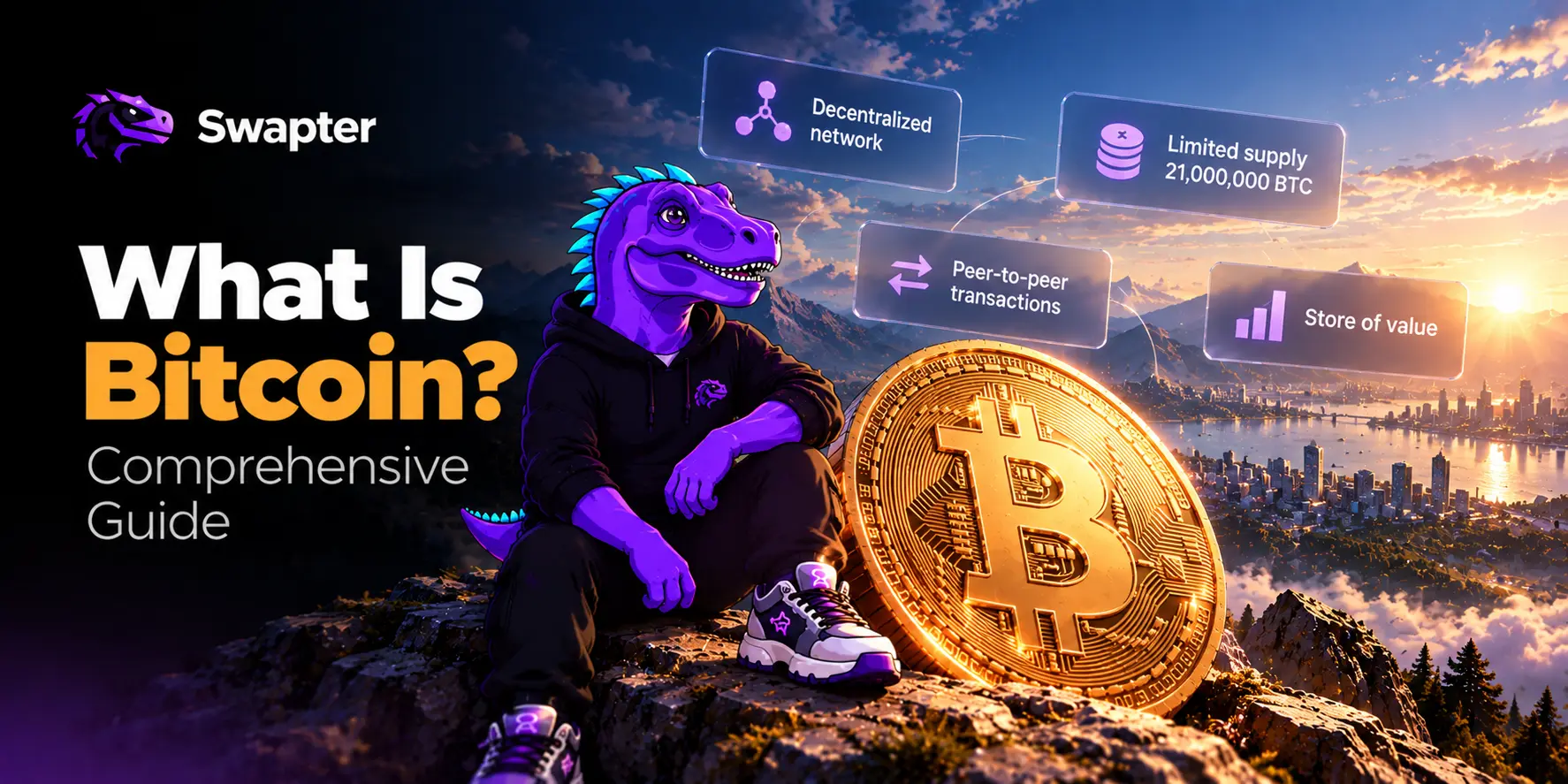
Bitcoin is a system that lets people transfer digital units of value directly to one another. What is Bitcoin in practical terms? It is a decentralized network where transactions are recorded on a public ledger maintained by thousands of computers. No bank has to approve the move, and no payment processor has to sit in the middle. This Bitcoin explained guide covers the underlying rules of the network, from transactions and mining to wallets and supply.
Anyone can install the software, examine every past transfer, and send funds to any other user who provides an address. The description first appeared in a technical paper published under the name Satoshi Nakamoto in October 2008. The network produced its first block in January 2009. The core rules written at that time continue to govern the system today.
The Basics: What Makes Bitcoin Different from Regular Money
Ordinary currency relies on institutions that control both the quantity of money and the permission to move it. Those institutions can increase the supply, block accounts or attach conditions to transfers. Bitcoin takes a different route.
| Feature | Bitcoin | Traditional Fiat Currency |
|---|---|---|
| Issuer and control | No central issuer; the network follows predefined protocol rules | Issued and managed by central banks and financial institutions |
| Supply limit | Capped at 21 million BTC | Supply can be increased through monetary policy |
| Transaction reversibility | Confirmed transactions are generally irreversible | Bank and card transactions may be reversed or disputed in certain cases |
| Intermediaries | Can be transferred directly between users | Payments commonly involve banks, payment processors, or other intermediaries |
| Storage | Controlled through private keys and wallets | Usually held through bank accounts or financial institutions |
The software itself fixes the total number of coins at 21 million and contains no mechanism for raising that ceiling. Fresh coins enter circulation only when miners complete a specific computational task, and the timetable for those releases is known in advance. Control over coins is demonstrated by possession of a private key, not by a record kept at a financial institution.
A Bitcoin transaction cannot normally be reversed by customer support or a central authority. If you lose the private key that controls your BTC, access to the funds may be permanently lost. Keep backups in a secure location and never share your private key or recovery credentials with another person.
Once a transfer has received several confirmations, services generally treat it as settled. That combination of autonomy and final responsibility has been present from the beginning.
Who Built Bitcoin, and Why
Who created Bitcoin has never been publicly confirmed. The original paper and the first version of the software were released under the name Satoshi Nakamoto. The identity behind the name remains unknown, and it is still unclear whether Satoshi Nakamoto was one person or a group.
The explicit aim was to construct electronic cash that would operate without trusted intermediaries and without the possibility of arbitrary inflation. Earlier attempts at digital money had collapsed because they depended on a central server to prevent the same funds from being spent more than once. Bitcoin distributed the verification task across the whole network of participants.
As more participants began running the software, the network continued to operate without a central operator. The coins mined during the first year have never been moved. The lack of an identified founder leaves the early history unfinished, yet it also means no individual can claim special rights over the protocol.
Inside a Bitcoin Transaction: From Wallet to Blockchain
A Bitcoin transaction starts in a wallet application, where the sender specifies the amount and destination address and authorizes the transfer with a private key.
- Create and sign the transaction. The wallet prepares the transfer and the sender authorizes it with a private key.
- Network verification. Nodes check the transaction against Bitcoin’s consensus rules. Valid transactions enter the mempool and wait to be included in a block.
- Block inclusion. A miner selects transactions from the mempool and includes them in a candidate block while performing the required proof-of-work.
- Confirmation. Other nodes verify the new block and add it to their copies of the blockchain. Additional blocks provide further confirmations and increase confidence that the transaction will not be reversed.
Mining: How New Bitcoin Enters Circulation
Bitcoin mining is an open competition to create the next valid block of transactions. Specialized equipment executes vast quantities of hash operations each second. The participant who locates a solution that satisfies the difficulty target gains the right to publish the block and receive the associated reward.
At present the reward consists of 3.125 newly created BTC together with the fees attached to the transactions inside the block. The difficulty level is recalculated every 2016 blocks so that the average interval between blocks remains approximately ten minutes. Every 210,000 blocks the size of the reward is reduced by half. This Bitcoin halving schedule has already occurred several times and will keep recurring until the last fractions of a coin are issued near the year 2140.
Mining therefore accomplishes two tasks at once. It raises the cost of rewriting earlier transaction history to prohibitive levels, and it releases new supply according to a schedule that can be inspected by anyone who reads the code. The energy required by the process constitutes the ongoing cost of that security and that issuance discipline.
What Actually Gives Bitcoin Its Value
Bitcoin is not backed by a physical commodity, a government undertaking, or a claim on future cash flows. Its market value develops through the interaction of limited supply, network resilience, and sustained demand. Bitcoin’s scarcity is one of the main factors that supports its market value. The ledger has continued without a successful alteration of its early history since the first block.
Demand originates from individuals who prefer a monetary asset that cannot be expanded by policy decision, from organizations that allocate part of their reserves to it, and from users who must move substantial amounts across national borders without depending on the banking system. As the number of holders and the number of accepting services increase, the practical usefulness of the network expands.
The market price represents only the most recent point at which buyers and sellers have agreed to trade. That price has advanced and retreated by wide margins on many occasions, while the rules that define the asset have remained fixed.
Reading a Bitcoin Address
A Bitcoin address is a sequence of characters that indicates where funds should be delivered. Addresses generated in recent years generally begin with bc1 and use Bech32 encoding. Earlier formats open with 1 or 3. The sequence is derived by hashing a public key and carries no name, contact detail or other personal data. Only the corresponding private key can later authorize expenditure of the coins that have been received.
One wallet is capable of producing a nearly unlimited set of addresses, and the customary advice is to employ a new address for each incoming payment. Public block explorers permit any observer to review the entire history of transactions linked to a given address. That visibility is intentional. It removes the requirement for a central record-keeper and allows every transfer to be verified by any interested party.
What People Actually Use Bitcoin For
Bitcoin is used in several ways, although long-term holding remains one of the most common.
- Long-term holding. Some users hold BTC as a long-term asset or as part of their savings.
- Cross-border transfers. Bitcoin can be used to move value between countries without relying entirely on traditional banking rails.
- Commercial payments. Some merchants accept BTC directly or through payment providers that convert it into local currency.
- Trading. Active market participants trade BTC against other digital and traditional assets.
- Corporate reserves. Some publicly listed companies hold BTC as part of their treasury strategies.
Bitcoin’s Price Journey So Far
The price history of Bitcoin has been marked by abrupt advances followed by extended contractions. In the opening years, an entire coin could be acquired for only a few dollars. The first peak that attracted broad notice arrived in late 2013 and was succeeded by a lengthy decline. The subsequent major rise concluded in December 2017 when the market briefly traded above 19,000 dollars.
Another multi-year retreat followed. In 2021 the price surpassed 60,000 dollars. What is the highest Bitcoin has ever been? Bitcoin reached an all-time high of approximately 126,000 dollars in October 2025, surpassing its previous record from March 2024. Between successive peaks the price has frequently fallen by 70 percent or more.
Those downturns have repeatedly forced short-term participants out of the market and tested the conviction of longer-term holders. With each cycle the market has grown more liquid, the set of participants has broadened, and the supporting infrastructure has become more developed. Price formation proceeds continuously across trading venues in numerous countries.
If you are learning how to buy Bitcoin, you can use a regulated exchange or a peer-to-peer service depending on your needs. Once BTC is in your wallet, Swapter lets you exchange Bitcoin for other digital assets without having to use a traditional trading platform.
FAQ
Is Bitcoin the same as blockchain?
Can Bitcoin be hacked?
How many Bitcoins exist?
Is Bitcoin legal everywhere?
Who controls Bitcoin?

Подпишитесь на нашу рассылку
Присоединяйтесь к нашей рассылке и будьте в курсе последних новостей.

© 2026 Swapter
Все права защищены