Menü
- Funktionsweise
- Partner
- Unterstützung
- Blog
- Über uns
- Kontaktiere uns
Sprache ändern:
Transaktions-ID
Tauschverfolgung
Tips
7. Oktober 2026
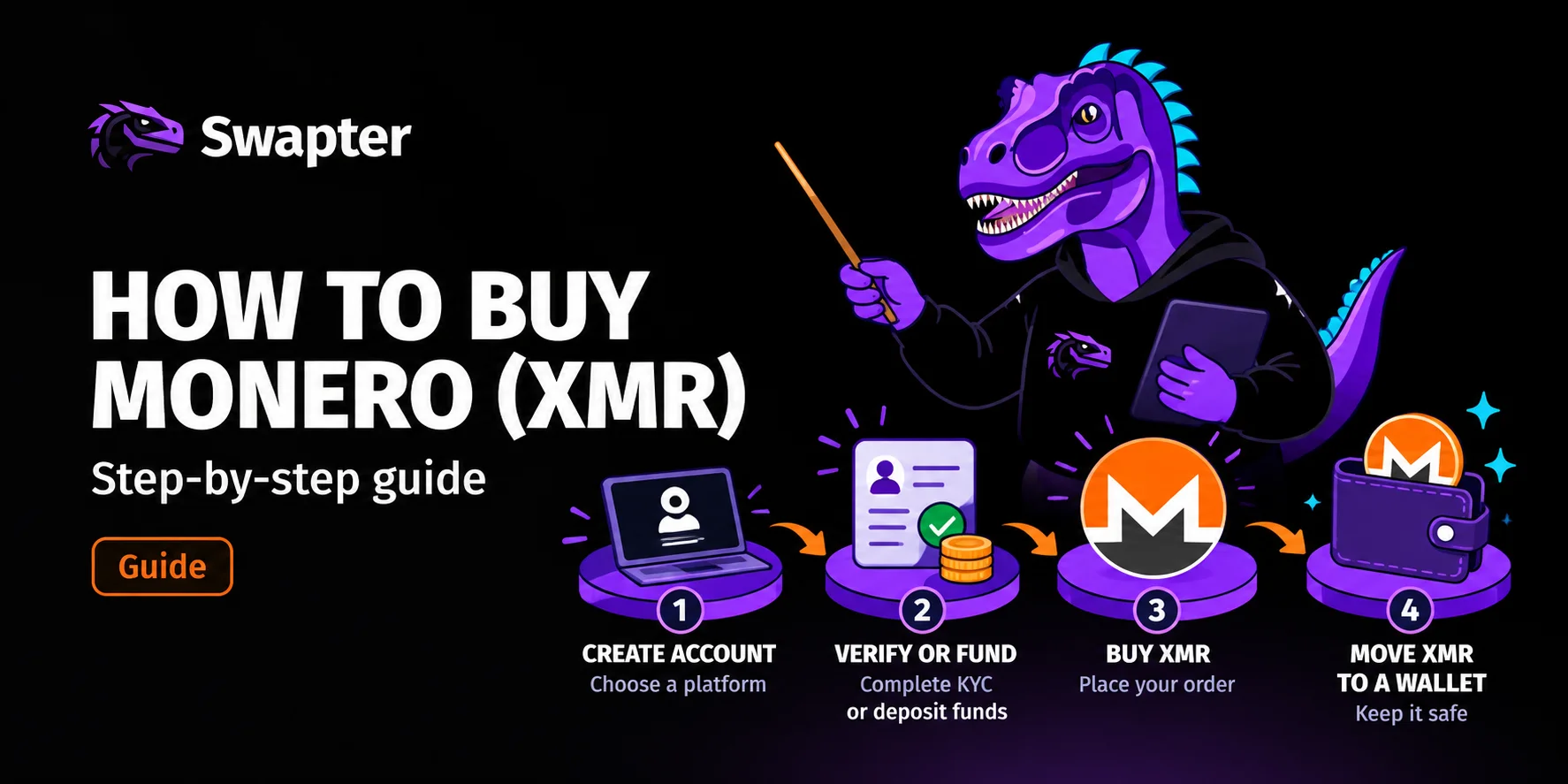
How to Buy Monero (XMR): Step-by-Step Guide
Inhalt
Buying Monero (XMR) is relatively straightforward once you understand the basic steps. You need a wallet that can receive XMR, a suitable way to purchase or exchange it, and a clear idea of how much you want to spend.
Monero is different from many other cryptocurrencies because privacy is built into the network by default. Stealth addresses, ring signatures and RingCT help conceal transaction participants and amounts.
For beginners, the main question is usually where to start. The answer depends on whether you prefer a regulated service with KYC, a crypto-to-crypto swap, a card payment or a method that requires less personal information. This guide covers the main options and explains what to check before sending your money.
What You Need Before Buying Monero
Before searching for how to buy Monero, prepare a wallet that supports XMR. Your wallet provides the address where purchased Monero can be received and gives you control over the funds after the transaction is completed.
The official Monero project provides a GUI wallet, CLI wallet, mobile and light wallets, as well as supported hardware wallet options. The current official download page also recommends verifying wallet software before using it.
A non-custodial wallet can be useful if you want to control your own keys. Store the recovery information securely and offline. Anyone who obtains your seed or private keys may be able to access the funds.
You should also decide how you want to pay. Depending on the provider and your location, you may be able to exchange another cryptocurrency for XMR, use a bank transfer or pay by card. Verification requirements can differ between providers, so check them before starting.
A simple preparation checklist is:
- an XMR-compatible wallet;
- a receiving address;
- a supported payment method;
- a reliable exchange or swap service;
- secure backup information.
If you want more background before making a purchase, our guide, Monero (XMR) Explained, can help you understand the network, its privacy model and the role of XMR.
How to Buy Monero Without KYC
The search for how to buy Monero without KYC usually relates to crypto-to-crypto exchanges, P2P transactions or other services that do not require a traditional account for every transaction.
A common route is to use an instant cryptocurrency exchange to swap an existing asset for XMR. You select the cryptocurrency you currently hold, choose XMR as the receiving asset, enter the amount and provide your Monero wallet address.
The process usually looks like this:
- Choose a service that supports an XMR exchange.
- Select the cryptocurrency you want to exchange.
- Select XMR as the cryptocurrency you want to receive.
- Enter the amount.
- Provide your XMR receiving address.
- Review the exchange rate and applicable fees.
- Send the required cryptocurrency.
- Wait for the exchange to process the transaction.
This approach can answer how to get Monero without first depositing funds into a conventional custodial account. It can also reduce the number of steps when you already hold another cryptocurrency.
However, the absence of KYC does not automatically mean complete anonymity. Information connected to your payment method, device, wallet activity or service provider can potentially create links to your identity. Requirements can also change according to the provider, transaction and jurisdiction.
For this reason, users should distinguish between a transaction that does not require identity verification and a transaction that leaves no identifying information. They are different things.
How to Buy Monero Anonymously
People researching how to buy Monero anonymously should consider both the purchase method and what happens afterward.
Monero itself provides strong on-chain privacy. Ring signatures obscure the actual signer among a group of possible signers, stealth addresses hide the recipient’s public destination, and RingCT hides transaction amounts. Monero’s technical documentation states that its sender, recipient and amount privacy are built into the protocol.
The purchase process is separate from those protocol-level features. If a service collects your name, payment details or identification documents, that information can still connect you with the purchase. A private blockchain transaction does not erase records created outside the blockchain.
Therefore, when considering how to buy the Monero cryptocurrency, look beyond the label of the service. Check whether an account is required, what information is collected, which payment method is used and where the purchased XMR will be sent.
Operational security matters as well. Use a wallet obtained from a trusted source, protect your seed phrase and check the receiving address carefully before confirming a transaction. The official Monero documentation also provides instructions for verifying wallet software and securing backups.
A privacy-focused purchase should therefore be viewed as a complete process rather than a single setting. Your payment method, exchange, wallet and personal security practices can all affect the level of privacy you actually achieve.
How to Buy Monero With a Credit Card
A credit card may be convenient for users who want to purchase XMR directly with fiat currency. However, card support for Monero is not universal, and some providers may require KYC before processing a purchase.
If you are comparing how to buy Monero with a credit card, first confirm that the provider supports both XMR and your card or payment region. You should also check whether the transaction is treated as a standard purchase or a cash-equivalent transaction by your card issuer.
The basic process is usually:
- Choose a provider that supports XMR purchases by card.
- Enter the amount you want to spend.
- Select XMR as the receiving asset.
- Complete KYC if required.
- Enter your XMR wallet address.
- Review the quoted exchange rate and total cost.
- Confirm the card payment.
- Check your wallet once the transaction is completed.
Card purchases can have several cost components. There may be a service fee, payment processing charge or spread between the market price and the provider’s quoted price. The final amount of XMR you receive is therefore more useful for comparison than the advertised fee alone.
When evaluating how to buy Monero (XMR) options for 2026, also check the provider’s current terms. Support for XMR, payment methods and verification requirements can change over time and may differ by jurisdiction.
Where to Store Monero After Buying
Understanding how to get XMR is only one part of owning Monero. After the purchase, you need to decide where the funds will remain.
A software wallet can be practical for smaller balances and regular transactions. The official Monero GUI wallet is available for Windows, macOS and Linux, while the project also provides CLI, mobile, light and hardware wallet options.
For larger holdings, some users prefer hardware wallets because private keys can remain isolated from a general-purpose internet-connected computer. The official Monero downloads page currently lists supported Ledger and Trezor devices.
The right option depends on how you use XMR:
| Storage option | Suitable for | Main consideration |
|---|---|---|
| Software wallet | Regular transactions | Convenient access |
| Mobile wallet | Everyday use | Device security is important |
| Hardware wallet | Larger or long-term holdings | Requires additional setup |
| CLI wallet | Advanced users | Greater control and technical complexity |
Regardless of the wallet type, protect your recovery information. Keep backups offline, use a strong wallet password and never give your seed phrase to anyone claiming to provide technical support.
Monero wallets can also work with either local or remote nodes. The official documentation notes that a local node gives users more direct control, while remote nodes can be used when running the blockchain locally is impractical.
FAQ
Can I buy Monero without an account?
Is buying Monero legal?
What’s the fastest way to buy XMR?
Can I buy Monero with a credit card directly?
Where should I store Monero after buying it?

Für unseren Newsletter anmelden
Abonnieren Sie unseren Newsletter und bleiben Sie über die neuesten Entwicklungen informiert.

© 2026 Swapter
Alle Rechte vorbehalten