Menu
- How it Works
- Partners
- Support
- Blog
- About
- Contact Us
Change Language:
Transaction ID
Swap Tracker
Tips
October 30, 2026
What Is Yield Farming and How Does It Work?
Contents
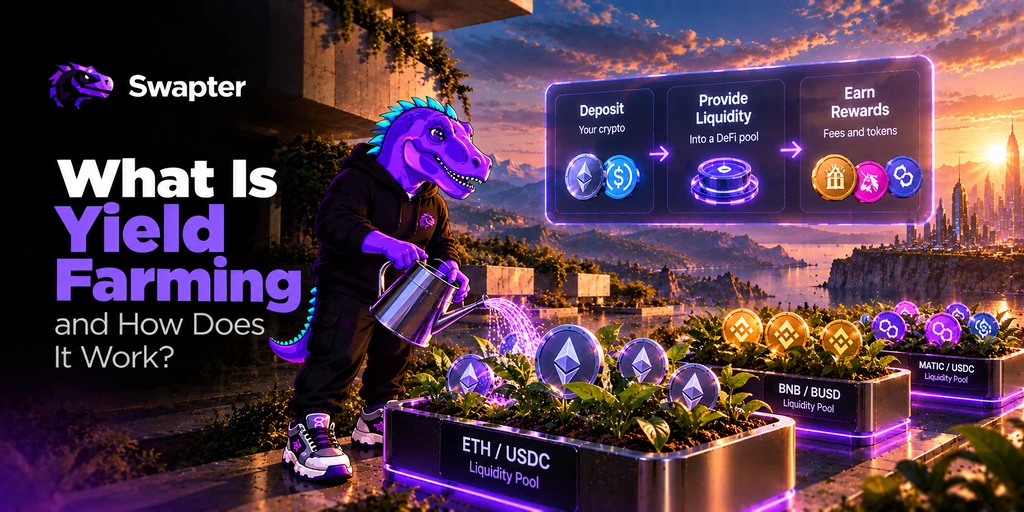
What is yield farming in simple terms? It is a DeFi strategy in which users supply crypto assets to liquidity pools, lending markets, or other protocols and receive returns for making that capital available. The income can come from trading fees, lending interest, protocol incentives, or a combination of these sources. For readers asking what is yield farming in crypto, the important point is that the return is generated by putting assets to work inside decentralized protocols rather than simply holding them in a wallet.
Yield farming became closely associated with the growth of DeFi because protocols needed liquidity for trading and lending. In return, they offered users a share of the fees or additional token rewards. The potential returns can be attractive, but they are variable and come with risks that do not exist when simply holding an asset.
How Yield Farming Works in Practice
How does yield farming work once the assets leave a wallet? The exact process depends on the protocol. On a DEX, a user may provide a pair of assets to a liquidity pool so other traders can swap between them. On a lending protocol, the user may supply a single asset that borrowers can access. The supplied capital then generates fees or interest according to the rules of that protocol. Save (formerly Solend), for example, allows users to supply supported assets and earn interest that changes with market utilization.
In some automated market makers, liquidity providers receive tokens representing their share of the pool. These positions can sometimes be deposited into another contract that distributes additional incentives. The exact form varies by protocol, so LP tokens should not be treated as a universal feature of every yield strategy.
A typical liquidity-farming process can look like this:
- Choose a protocol and a suitable pool or lending market.
- Check the assets involved, current yield, fees, and available liquidity.
- Deposit the required assets through a connected crypto wallet.
- Receive a token or position representing the supplied capital, where applicable.
- Claim or automatically receive fees and additional incentives.
- Monitor the position and withdraw when the expected return no longer justifies the risk.
At this level, yield farming is simply a way of earning from capital that would otherwise remain idle. The return is determined by the activity and rules of the protocol, so the advertised APY can change after the position is opened.
Where the Returns Actually Come From
Yield farming can generate income from several sources, and separating them is important when evaluating a farm. The first source is trading fees. When users trade through a liquidity pool, part of the fee can be distributed to liquidity providers. The amount earned depends on trading volume, the pool’s fee structure, and the provider’s share of the liquidity.
The second source is lending interest. A lending protocol connects suppliers with borrowers and uses the interest paid by borrowers to compensate suppliers. On Aave, for example, supply rates are influenced by the utilization of each market, meaning that the return can change as borrowing demand changes.
The third source is protocol incentives. A DeFi project may distribute its own token to attract liquidity to a particular pool or market. These rewards can increase the displayed APY, but their market value can change quickly. If the incentive token falls in price, the actual return measured in USD or another base asset can be much lower than the headline APY suggests.
Understanding yield farming in DeFi, therefore, depends on looking beyond the displayed percentage. A high APY can contain a large incentive component that may decline as more users enter the same strategy.
Yield Farming vs Staking
Yield farming vs staking describes two different approaches to earning returns from crypto assets. Staking generally involves committing assets to a proof-of-stake network or a staking service so that they can contribute to network security and earn protocol rewards. On Ethereum, validators stake ETH and receive rewards for participating correctly, while certain forms of dishonest behavior can result in slashing.
Yield farming usually focuses on deploying capital inside DeFi applications. A user may provide liquidity to a DEX, supply assets to a lending market, or move capital between different strategies to pursue available returns. The position can therefore involve several smart contracts and, in the case of liquidity pools, exposure to changing asset prices.
| Feature | Yield farming | Staking |
|---|---|---|
| Main purpose | Earn from DeFi activity and incentives | Support network consensus and earn rewards |
| Typical assets | One or more tokens | Usually the network’s staking asset |
| Main return sources | Fees, lending interest, incentives | Protocol staking rewards |
| Key risks | Smart contracts, market movements, impermanent loss | Slashing, penalties, lockups or provider risk |
| Complexity | Often higher | Usually simpler, depending on method |
The distinction is not always absolute. Some staked assets can be represented by liquid staking tokens and then used in DeFi strategies. This creates additional yield opportunities while also adding another layer of smart-contract and market risk. Readers who want to understand the underlying staking model can consult What Is Staking and How Does It Work?
Impermanent Loss Explained
In practical terms, impermanent loss is the difference between the value of assets held through a liquidity position and the value those same assets would have had if they had simply remained outside the pool.
The effect appears when the relative price of the assets in a liquidity pool changes. In a traditional constant-product AMM, the pool automatically adjusts its asset balances as traders buy one token and sell the other. As a result, the liquidity provider can end up holding more of the asset that has underperformed and less of the asset that has appreciated.
The loss is called impermanent because the difference can shrink if the relative prices return toward the original ratio. If the provider withdraws while the price ratio remains significantly different, however, the difference becomes a realized loss compared with simply holding the original assets.
Trading fees and other rewards can offset impermanent loss. Whether they do so depends on the amount of fee income, the size of the price movement, the duration of the position, and the incentives attached to the pool.
Yield Farming Risks That Matter
Yield farming risks come from several sources, and a high APY does not remove them.
Smart-contract risk is one of the most important. A vulnerability in the protocol or one of its dependencies can result in partial or total loss of deposited assets. An audit can provide useful information about the code, but it does not guarantee that a protocol is safe.
Impermanent loss affects liquidity positions when the relative prices of paired assets move. A pool with highly volatile assets can experience a much larger difference than a pool containing assets with closely correlated prices.
Token price risk also matters. If a large part of the yield is paid in a protocol token and that token loses value, the nominal APY can significantly overstate the actual return.
Liquidity and withdrawal risk should also be considered. A protocol can have insufficient available liquidity during periods of market stress, potentially making it harder to exit a position at the expected value. Lending protocols can also impose specific withdrawal conditions depending on available liquidity.
Stablecoin yield farming risks are different in emphasis. When both assets in a liquidity pair are designed to track the same fiat currency, price divergence may be smaller, which can reduce impermanent-loss exposure. However, users still face smart-contract risk, liquidity risk, incentive-token volatility, and the possibility that a stablecoin loses its intended peg. A comparison of the main options, including USDT and USDC, can be found in USDT vs USDC vs Other Stablecoins.
FAQ
Is yield farming still profitable in 2026?
What’s the difference between yield farming and liquidity mining?
Can you lose money yield farming?
Do I need to know DeFi to start?
What’s a reasonable APY to expect?

Sign up for our newsletter
Join our newsletter and stay tuned with the latest insights.
