Menu
- How it Works
- Partners
- Support
- Blog
- About
- Contact Us
Change Language:
Transaction ID
Swap Tracker
Tips
October 8, 2026
What Is a Smart Contract? A Beginner’s Guide to How They Work
Contents
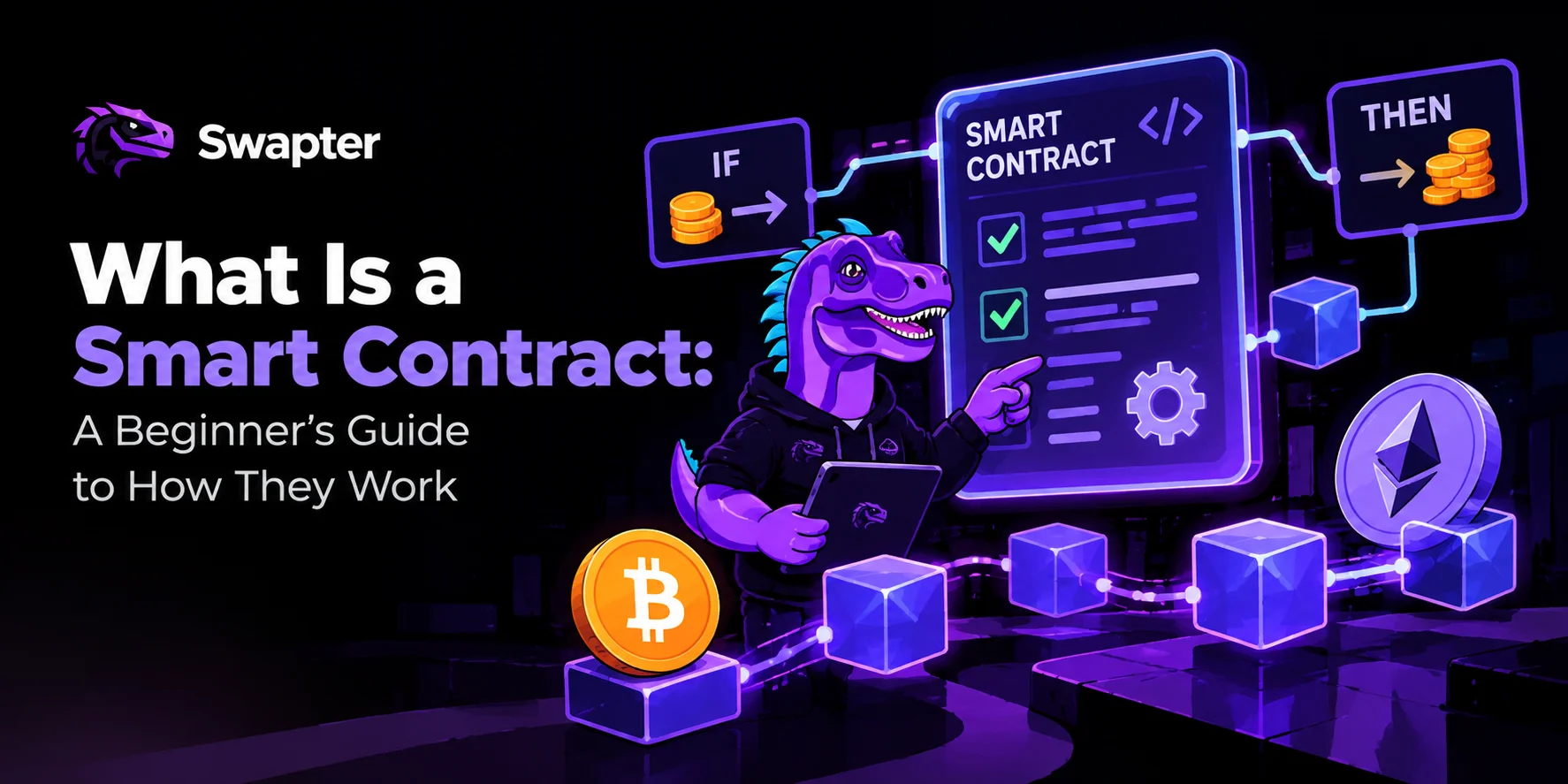
Smart contracts are one of the main building blocks of blockchain applications. Smart contracts are a blockchain technology used to create programmable applications that can execute predefined rules and record the results directly on a decentralized network. Instead of relying on a person to approve every action, a smart contract can perform specific operations when its programmed conditions are met.
If you are wondering what a smart contract is, the simplest explanation is a program stored on a blockchain that executes specific instructions when the required conditions are satisfied. On Ethereum, smart contracts run inside the Ethereum Virtual Machine (EVM), while users interact with them by sending transactions or calling available functions.
A simple example is digital escrow. A buyer can send funds to a contract, the contract can check whether predefined conditions have been met, and the funds can then be released according to its programmed rules. The process does not require an employee to manually approve each step.
This guide explains smart contracts in practical terms, covering how they work, where they are used, their main benefits and the limitations users should understand before interacting with blockchain applications.
How Do Smart Contracts Work?
A smart contract starts as code written by a developer. The code defines what the contract can do, what information it stores and which conditions must be satisfied before a particular action is performed. On Ethereum, Solidity and Vyper are two of the main languages used for smart contract development.
Once the code has been written and tested, it is compiled into bytecode that the Ethereum Virtual Machine can execute. The developer then deploys this bytecode to the blockchain through a transaction. Deployment requires ETH to pay network gas, and deploying a contract generally requires more gas than sending a simple ETH transaction.
So, how do smart contracts work in practical terms? The process usually follows several stages:
- A developer writes the contract rules.
- The code is compiled into blockchain-compatible bytecode.
- The contract is deployed through a blockchain transaction.
- A user or application interacts with the contract.
- The blockchain processes the requested function.
- The resulting state change is recorded on-chain.
For example, a token contract can contain functions for transferring assets between addresses. A decentralized exchange can use smart contracts to process swaps according to predefined rules. A lending protocol can use them to manage deposits, borrowing positions, collateral and repayments.
One important characteristic of smart contracts is composability. A contract can interact with other contracts, allowing developers to combine existing blockchain functions into more complex applications. This approach has played an important role in the development of DeFi and other Web3 applications.
Smart contracts also have limitations. Code executes according to its programmed logic, including when that logic contains an error. A vulnerability can therefore affect how an application operates or, in some cases, put user funds at risk. Testing, security reviews and appropriate access controls are important before a contract is deployed.
Types of Smart Contracts
There are several types of smart contracts, and the categories can overlap because one contract may perform multiple functions.
Token contracts define how digital assets are created, transferred and managed. Fungible tokens can represent units of an asset, while other standards support NFTs and different forms of digital ownership.
For example, an ERC-20 contract can define the supply and transfer rules for a fungible token. Wallets and decentralized applications can then interact with the contract through its available functions.
Financial contracts are widely used across DeFi. They can support activities such as token swaps, lending, borrowing, staking and liquidity provision.
Instead of requiring a financial institution to manually process every operation, the application’s logic is encoded in smart contracts. Users interact with that logic through a crypto wallet and a decentralized application.
Governance contracts can help communities manage proposals and voting. Depending on the design, eligible participants can vote on protocol changes, treasury allocations or other decisions.
Different projects use different governance structures. Some rely on token-based voting, while others use delegation, voting thresholds and additional safeguards.
Developers can also create contracts for specific applications and business processes. Examples include escrow systems, blockchain games, marketplaces, payment systems and digital ownership platforms.
The flexibility of this model is one reason smart contract technology has become an important part of blockchain development.
What Are Smart Contracts Used For?
People often ask what smart contracts are used for when they first encounter blockchain applications. Their use depends on the network and application, but several categories have become particularly common.
DeFi applications use smart contracts to automate financial operations. A user can connect a wallet to an application and interact with contracts that determine how deposits, swaps, loans or other operations are processed. To see how decentralized finance compares with centralized alternatives, our guide, DeFi vs CeFi, breaks down the key differences between these approaches.
For example, a decentralized cryptocurrency exchange can use smart contracts to execute token swaps. A lending protocol can use contracts to record deposits, manage collateral and apply its predefined rules.
Token creation
Smart contracts can establish rules for digital tokens, including their supply, transfers and other functions. This makes them useful for cryptocurrencies, stablecoins, governance tokens and other blockchain-based assets.
NFT systems use smart contracts to define ownership records and interactions with digital assets. Depending on the design, a contract can manage minting, transfers, access rights and other functions.
Games can use smart contracts to manage digital assets, in-game items and selected game mechanics. Players may be able to own and transfer blockchain-based assets through compatible applications.
Smart contracts can hold assets and release them when predefined conditions are satisfied. This can be useful for escrow arrangements, automated payments and other processes where transaction conditions need to be enforced by code.
Smart contracts can also coordinate activities involving decentralized physical infrastructure and blockchain-based services. If you are unfamiliar with this concept, our guide, What Is DePIN, explains how decentralized physical infrastructure networks connect blockchain technology with real-world resources.
Benefits of Smart Contracts
The benefits of smart contracts come from combining programmable rules with blockchain infrastructure. Their value depends on how the contract is designed and what problem the application is intended to solve.
A smart contract can execute a predefined action after receiving the required input. This can reduce manual processing and make certain workflows easier to automate.
For example, an application can encode payment conditions directly into a contract rather than requiring an intermediary to manually confirm every stage of a transaction.
Smart contracts deployed on public blockchains can generally be inspected through blockchain explorers and other tools. Users can review contract addresses, transactions and, where source code has been verified, the code itself.
Transparency does not guarantee that a contract is safe. Users still need to understand what they are approving and whether the contract has been properly reviewed.
A smart contract follows the logic encoded in its program. When the required conditions are met, the relevant instructions can execute without waiting for a separate manual decision.
This can be useful when multiple parties need to follow the same predefined rules.
Smart contracts can interact with other contracts. Developers can therefore combine existing components instead of building every function from scratch.
This has helped create interconnected DeFi applications where different protocols can communicate through on-chain functions.
Public blockchain contracts can generally be accessed by users who meet the technical requirements for interacting with the network. This can allow blockchain applications to operate across borders without requiring users to create a separate traditional account for every service.
There are still practical limitations, including network fees, local regulations, wallet compatibility and application-specific restrictions.
Smart contracts can automate processes that traditionally require an intermediary. The degree of reliance depends on the application because some systems still use administrators, developers, price oracles, bridges or other external components.
The main advantage is that certain rules can be enforced directly through blockchain-based code.
Can You Create a Smart Contract Yourself?
Yes, you can create a smart contract yourself if you have the necessary programming knowledge and are prepared to learn the relevant blockchain development tools. Ethereum is permissionless, so anyone can write and deploy a contract if they have the required technical knowledge and enough ETH to cover deployment costs.
If you are searching for how to create a smart contract, a practical beginner workflow can look like this:
- Choose a blockchain. Ethereum and other EVM-compatible networks support smart contract development.
- Select a programming language. Solidity is widely used, while Vyper provides an alternative for Ethereum development.
- Define the contract logic. Decide what the contract should store, which functions users can call and what conditions each function requires.
- Write and test the code. Use a suitable development environment and test the contract before deploying it to a live network.
- Review security. Check access controls, input validation and potential attack scenarios.
- Deploy the contract. The compiled bytecode is submitted to the blockchain through a transaction that requires network gas.
- Verify and monitor it. Where supported, developers can verify the source code and monitor activity after deployment.
For a beginner, the testing stage deserves particular attention. A smart contract may control valuable assets, and a programming error can produce unexpected results. Professional security audits can also be appropriate for contracts that manage significant amounts of money.
Another important consideration is whether a contract can be upgraded. Deployed smart contract code is generally immutable, but developers can use proxy contracts and other upgrade mechanisms to introduce changes. Users should therefore understand the governance and upgrade model before interacting with an unfamiliar protocol.
FAQ
Are smart contracts legally binding?
A smart contract is software, while a legal contract is an arrangement recognized under applicable law. Whether a particular smart contract creates legally enforceable obligations depends on the jurisdiction, the parties involved, the terms of the arrangement and the surrounding circumstances.
Using blockchain code does not automatically make an agreement legally binding in every country. Businesses should consider applicable laws and obtain professional legal advice when a transaction has significant legal or financial consequences.
Can a smart contract be changed after deployment?
The code of a standard deployed smart contract is generally immutable. However, some projects use upgradeable architectures, including proxy contracts, that allow the underlying logic to be changed through predefined mechanisms.
This means users should check whether a protocol is immutable or controlled by an administrator, multisignature wallet or governance system with upgrade authority.
Do you need to know how to code to use smart contracts?
No. Most users interact with smart contracts through wallets and decentralized applications without writing any code themselves.
Programming knowledge becomes important when you want to create, test, audit or modify a contract. Solidity and Vyper are among the main languages used for Ethereum smart contract development.
What happens if there’s a bug in a smart contract?
The outcome depends on the nature of the bug and the contract’s design. A minor error may cause a transaction to fail, while a serious vulnerability can potentially allow unauthorized actions or result in financial losses.
Because deployed blockchain code can be difficult to modify or reverse, developers should test contracts carefully and consider security audits before deployment.
Which blockchain is best for smart contracts?
There is no single blockchain that is best for every smart contract project. The appropriate choice depends on factors such as security, ecosystem, transaction costs, scalability, programming environment, liquidity and compatibility with other applications.
Ethereum remains one of the major smart contract platforms, with an extensive developer ecosystem and broad support for decentralized applications.
For users who need to move cryptocurrency before interacting with a blockchain application, Swapter can provide a convenient way to convert supported assets.

Sign up for our newsletter
Join our newsletter and stay tuned with the latest insights.
