Menu
- How it Works
- Partners
- Support
- Blog
- About
- Contact Us
Change Language:
Transaction ID
Swap Tracker
Tips
October 21, 2026
What Is a Rug Pull and How to Spot One Before You Invest
Contents
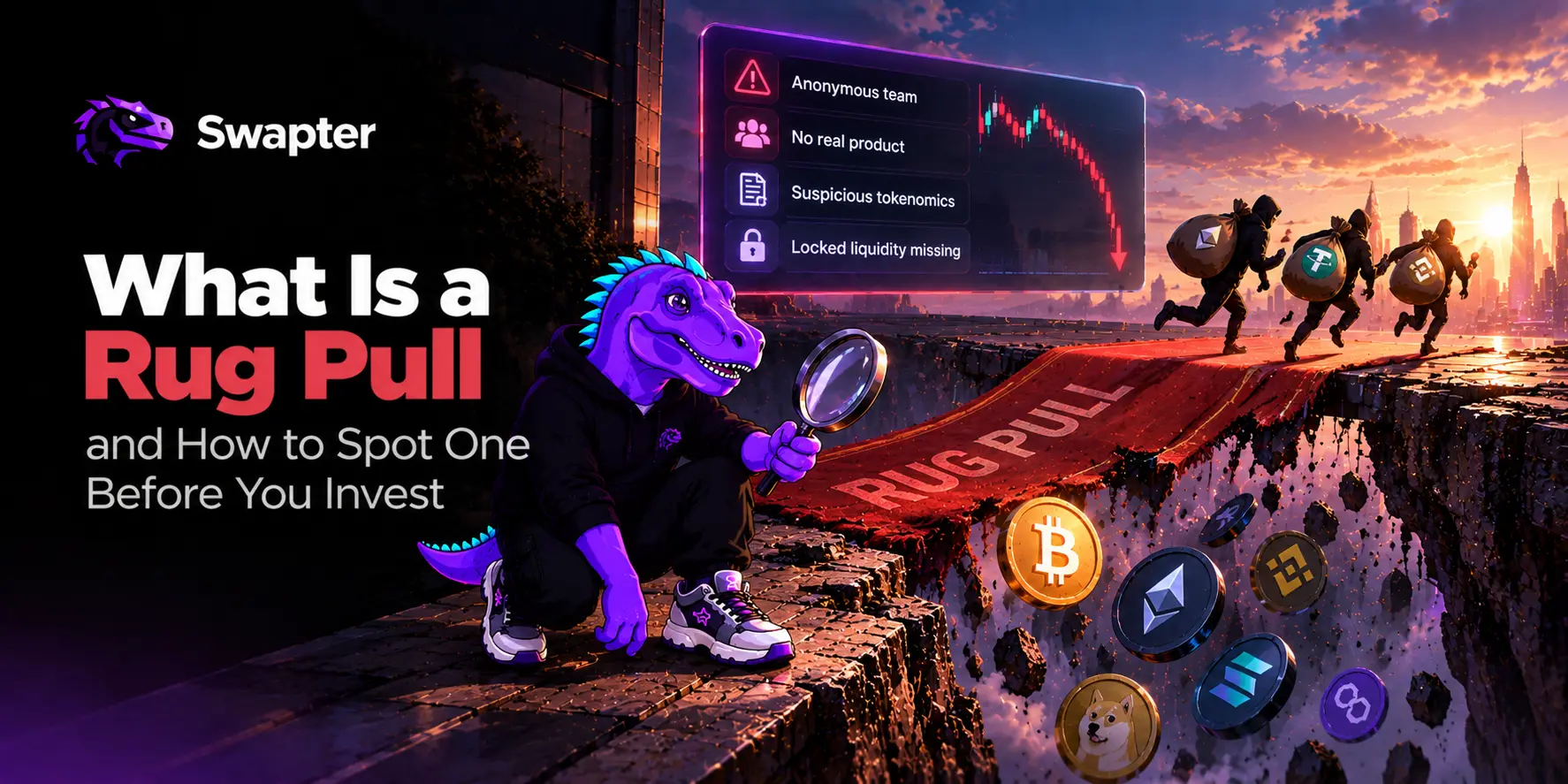
What is a rug pull when the jargon is stripped away? It is a planned exit by the creators of a crypto project after they have taken money from people who bought the token. The team launches a token or project, builds interest, attracts funds or liquidity, and then uses its control to extract value or simply abandons the project.
Holders are left with tokens that become almost impossible to sell. The phrase itself comes from the picture of yanking a rug from under someone’s feet. The term rug pull refers to a sudden exit in which the people behind a project remove liquidity or abandon the project after attracting investors.
The Anatomy of a Rug Pull
A rug pull in crypto is an exit scam that takes advantage of how open and lightly supervised many decentralized markets remain. A group issues a token, most often on a decentralized exchange, pairs it with something liquid like ETH or USDT, and pushes hard on social channels. Once buyers have piled in and the liquidity pool looks healthy, the same group removes that liquidity or simply vanishes.
The tokens that remain trade at a fraction of their earlier price, if they trade at all. Cryptocurrency rug pull operations lean on the speed and relative anonymity that blockchain tools allow. Smart contracts can be written with special rights reserved for the creators, allowing the exit to be executed in a single transaction.
How the Scam Actually Plays Out
How do crypto rug pulls work from start to finish? The process usually begins with a newly launched token and an intense burst of promotion designed to attract attention quickly. Social media accounts, paid influencers, referral schemes, and community groups create the impression that the project is gaining momentum and that significant utility or new features are coming soon.
Early buyers see the price rising and may bring in friends or share the project with others, which increases trading activity and helps build liquidity. As more people enter, the token can appear increasingly legitimate and successful, even when the underlying project has little substance.
At a moment chosen by the creators, the scheme can collapse in several ways. They may withdraw liquidity from the trading pool, mint a large additional supply that sharply reduces the value of existing holdings, or simply disappear and stop development, communication, and support. Once confidence breaks, the price can fall dramatically, sometimes within minutes. Holders may find that there are few buyers left and that selling the token has become difficult or impossible. Later security reviews often reveal that the smart contract contained functions allowing the creators to control the token supply, change important parameters, or move funds under conditions that ordinary holders did not fully understand.
The complete cycle can therefore move from launch and aggressive promotion to rapid price growth and eventual collapse in a very short period. Some rug pulls develop over several days or weeks as the team gradually builds credibility, while others are designed to fail within a single afternoon.
The speed of the collapse does not change the underlying pattern: attention attracts buyers, new demand increases the apparent value of the token, and the creators eventually use their control over liquidity, supply, or the contract to extract value from holders.
Rug Pull, Hack, or Just a Bad Investment? Telling Them Apart
A crypto rug pull is not the same as a hack. In a hack an outside attacker finds a weakness and steals funds against the wishes of the project team. In a rug pull the team itself is the party taking the value. An ordinary price drop caused by weak markets or by failure to deliver promised features sits in a different category; it can result from poor management rather than from planned fraud.
The key marker of a rug pull is the intentional construction of the exit. Contracts that permit unlimited minting, free withdrawal of liquidity, or other privileged moves by the developers usually signal that the project was designed with an escape route already in place.
The Red Flags That Show Up Before the Rug Gets Pulled
Avoiding rug pulls starts with careful examination before any money is sent. Certain warning signs keep appearing:
- Anonymous or unverifiable team. The developers remain anonymous or present identities that cannot be independently verified.
- No credible audit. The smart contract has never been audited by a known firm, or the available audit is incomplete, difficult to find, or fails to address important contract permissions.
- Unlocked liquidity. Liquidity remains unlocked or is controlled solely by the developers.
- Price-focused marketing. Promotional material focuses heavily on rising prices, referral bonuses, or guaranteed-looking returns instead of demonstrating working technology.
- Weak or copied documentation. The whitepaper is vague, appears copied from another project, or promises development timelines that seem unrealistic.
- Artificial community activity. Social channels show signs of bot activity, paid promotion, or unusually aggressive engagement.
- Concentrated token ownership. A large share of the supply sits in a small number of wallets that could sell or otherwise affect the market at any time.
One of these factors is reason for caution. Several together form a pattern that is hard to ignore.
Rug Pulls That Made Headlines
The biggest crypto rug pulls show how quickly losses can reach millions of dollars when a project gives its creators excessive control over liquidity, token supply, or contract functions. Among the most famous crypto rug pulls, several cases stand out because of the speed and scale of the losses.
| Project | Year | Approx. loss | What happened |
|---|---|---|---|
| Thodex | 2021 | Over $2 billion | The exchange halted withdrawals and its founder disappeared with control over customer funds. |
| AnubisDAO | 2021 | About $58-60 million | Funds were removed from the project’s liquidity pool shortly after launch. |
| Meerkat Finance | 2021 | About $31 million | The project was drained of BUSD and BNB through control over its vault contracts. |
| TurtleDex | 2021 | About $2.4-2.5 million | Developers drained liquidity from BSC trading pools and the project’s online presence disappeared. |
| Squid Game Token | 2021 | About $3.38 million | The project restricted selling and its developers reportedly withdrew the funds after the token price surged. |
These incidents demonstrate that a large community, rapid price growth, or extensive social media activity does not necessarily prove that a project is legitimate. Some fraudulent projects deliberately create an active community before the exit, using promotional campaigns and rising prices to encourage more purchases.
In other cases, the warning signs are hidden in the smart contract, where developers retain permissions that allow them to change supply, restrict selling, or withdraw liquidity. Investors may only discover these controls after the project begins to collapse.
These cases also show why the amount invested is not the only factor that matters. A token can attract substantial liquidity and thousands of holders within a short period, making the project appear established even when it has only a small team controlling critical functions. Once that control is used against the holders, selling pressure can overwhelm the remaining market and cause the token price to fall sharply.
These episodes share the same basic outline: rapid hype, concentrated control over liquidity or supply, growing participation from new buyers, and a sudden exit. The sums involved differ, yet the sequence remains familiar enough that people who have followed several such cases tend to approach brand-new tokens with greater caution. Checking the contract permissions, liquidity arrangements, team transparency, and ability to sell before buying can reveal risks that promotional material often leaves out.
Due Diligence That Actually Protects You
Real protection comes from concrete steps rather than from hope.
- Check the smart contract. Look for mint rights, owner privileges, liquidity controls, and other functions that could give developers excessive control.
- Verify liquidity arrangements. Confirm that liquidity is locked for a meaningful period and that the locker is a known third-party service.
- Research the team. Try to verify the people behind the project and check whether they have a credible history of previous work.
- Compare claims with on-chain data. Check whether the project’s marketing statements match its actual activity, token distribution, and liquidity.
- Review independent audits. Give preference to projects that publish complete audit reports from established security firms.
- Limit your exposure. Keep any position in a newly launched token small enough that a complete loss would not damage your overall finances.
For related risks that often travel with new token launches, see how to avoid fake crypto swap sites & scams. No list of checks removes every possible danger, but consistent use of these steps lowers exposure to the most frequent forms of exit scam.
FAQ
Is a rug pull illegal?
Can you get your money back after a rug pull?
How is a rug pull different from a hack?
Are all new tokens risky?
What’s the biggest red flag in a rug pull?
Sign up for our newsletter
Join our newsletter and stay tuned with the latest insights.