Menu
- How it Works
- Partners
- Support
- Blog
- About
- Contact Us
Change Language:
Transaction ID
Swap Tracker
Tips
October 5, 2026
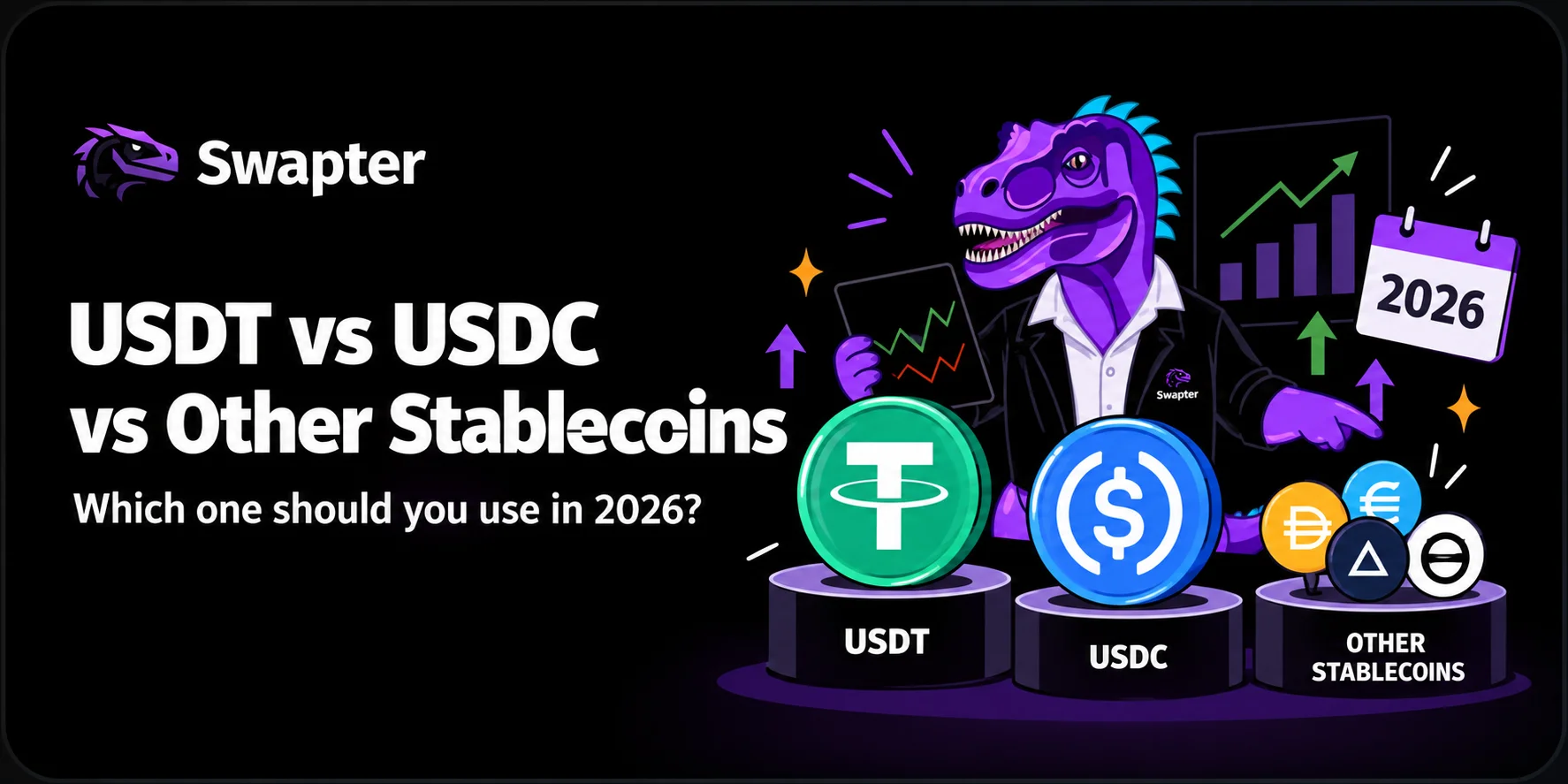
USDT vs USDC vs Other Stablecoins: Which One Should You Use in 2026?
Contents
Stablecoins have become a standard part of the crypto market. They give users a way to hold and transfer dollar-denominated value without taking the same price swings associated with BTC or ETH. Traders use them to move between positions, DeFi users rely on them for liquidity and collateral, and businesses can use them for digital payments and settlements.
What Are Stablecoins and Why They Matter
A good list of stablecoins in 2026 includes fiat-backed assets such as USDT and USDC, as well as protocol-based assets such as USDS. The underlying mechanisms are different, so the word «stablecoin» does not describe one single risk model.
Types of Stablecoins Explained
One of the main benefits of stablecoins is reduced exposure to market volatility. Holding $1,000 in a dollar-denominated stablecoin is fundamentally different from holding $1,000 worth of ETH during sharp market movements, as stablecoins are designed to maintain a value close to the underlying fiat currency.
Stablecoins can also simplify financial planning and provide faster settlement. A business can keep part of its working capital in a dollar-denominated stablecoin and use it for payments or transfers without taking the same level of price risk as with more volatile crypto assets. Transfers can also settle on a blockchain at any time, making stablecoins useful for moving funds between crypto exchanges without relying on traditional bank transfers.
Different stablecoins use different mechanisms to maintain their peg.
For example, USDS uses a collateral-based model, while Maker’s Peg Stability Module (PSM) helps maintain price stability by allowing users to exchange approved collateral such as USDC for the protocol’s stablecoin at a predefined rate, subject to fees and limits. This creates an arbitrage mechanism that can help keep the stablecoin’s market price close to its target value and illustrates how protocol design can directly influence a stablecoin’s stability and risk profile.
USDT vs USDC: Key Differences
The basic goal of USDT and USDC is similar, but the difference between USDT and USDC lies in how each stablecoin is issued and managed. Both are designed to maintain a value close to one US dollar, making them useful for trading, payments, and transferring funds within the crypto ecosystem. However, they differ in terms of their issuers, reserve structures, transparency, and regulatory approaches. USDT is issued by Tether, while USDC is issued solely by Circle, with Coinbase acting as a distribution partner and minority shareholder in Circle.
Issuer and Transparency
Circle follows a more frequent public disclosure model for USDC. According to its transparency page, the company provides weekly updates on USDC reserve holdings, as well as information on minting and redemption activity. This regular reporting gives users greater visibility into how USDC is backed and how its supply changes over time.
Reserves and Audits
Circle states that USDC is backed by highly liquid cash and cash-equivalent assets. Its reserve structure includes bank deposits, short-dated U.S. Treasuries, and overnight reverse Treasury repos. This composition is intended to ensure that sufficient liquid assets are available to support USDC redemptions and maintain its 1:1 peg to the U.S. dollar. The emphasis on highly liquid, short-term assets also helps reduce exposure to significant market fluctuations and supports the stablecoin’s overall stability.
Blockchain Availability and Network Fees
USDT is available across a wide range of networks. Tether’s current supported-protocol page lists Ethereum, Tron, Solana, Avalanche, BNB Smart Chain, Celo, Kaia, Polkadot AssetHub, Tezos, TON, Aptos and others.
USDC also has broad multi-chain availability. Circle lists support across numerous networks, including Ethereum, Solana, Arbitrum, Avalanche, Base, Optimism, Polygon, Sui and others. Its European documentation also lists USDC availability across multiple networks used in the EU.
Adoption and Liquidity
Tether reported approximately $184.6 billion of USDT in circulation at the end of Q2 2026. Circle reported $73.3 billion of USDC in circulation at the end of the same quarter, so these figures refer to the same reporting date and can be compared directly.
Other Popular Stablecoins Compared
USDS is one of several protocol-based stablecoin examples, issued by Sky Protocol. Sky says it is backed by protocol collateral and uses the Peg Stability Module to help maintain a 1:1 peg. It is mainly relevant to users who already work with DeFi and the Sky ecosystem.
PYUSD is issued by Paxos for PayPal and is designed for payments. Paxos describes it as a fully backed U.S. dollar-denominated stablecoin available on multiple blockchains and suitable for payments, transfers and Web3 applications.
RLUSD is Ripple’s dollar-backed stablecoin. Ripple currently lists RLUSD on XRP Ledger, Ethereum, Base, Ink, Optimism, Unichain and the XRPL EVM sidechain. Its reserves consist of cash and cash equivalents, including short-term U.S. Treasury bills, government money-market funds, repos and deposits. Ripple says monthly reserve attestations are conducted by Deloitte.
USDP is issued by Paxos and is backed by cash and cash equivalents. Paxos states that USDP is redeemable 1:1 for U.S. dollars and publishes monthly reserve reports alongside independent third-party attestations.
Benefits of Using Stablecoins
One of the main benefits of stablecoins is reduced exposure to market volatility. Holding $1,000 in a dollar-denominated stablecoin is fundamentally different from holding $1,000 worth of ETH during a period of sharp market movement, as the stablecoin is designed to maintain a value close to the underlying fiat currency. This makes stablecoins useful for users who want to remain within the digital-asset ecosystem without taking on the full price volatility of assets such as Bitcoin or Ether.
Stablecoins can also simplify financial planning when funds need to remain in digital form for a period of time. A business can keep part of its working capital in a dollar-denominated stablecoin and use it for payments or transfers without taking the same level of price risk associated with more volatile crypto assets.
Another benefit is faster settlement. Stablecoin transfers can generally be sent and settled on a blockchain at any time, without depending on the operating hours of traditional banks or the processing times of correspondent banking networks. This can be particularly useful for moving funds between crypto exchanges: instead of withdrawing fiat to a bank account, waiting for the transfer to clear, and then depositing the funds at another exchange, a trader can transfer a supported stablecoin directly between blockchain addresses.
Which Stablecoin Should You Choose?
Choose USDT when liquidity and cryptocurrency exchange availability are the main priorities. Its large circulation and broad market presence make it convenient for active trading and transfers between crypto services.
Choose USDC when reserve transparency, regulated infrastructure or DeFi compatibility are more important. Its disclosure model and MiCA framework are particularly relevant for users operating in Europe.
Choose USDS when you specifically want a DeFi-focused stablecoin and understand its protocol-based model. Its collateral and peg mechanisms differ from those of conventional fiat-backed stablecoins.
You can exchange stablecoins on Swapter without registration.
FAQ
Is USDT or USDC safer?
Can I swap USDT for USDC instantly?
Which stablecoin has lower fees?
Are stablecoins really pegged 1:1 to the dollar?
What happens if a stablecoin loses its peg?

Sign up for our newsletter
Join our newsletter and stay tuned with the latest insights.
