Menu
- How it Works
- Partners
- Support
- Blog
- About
- Contact Us
Change Language:
Transaction ID
Swap Tracker
Tips
September 14, 2026
Monero (XMR) Explained: How It Works and Why It’s Different from Bitcoin
Contents
Monero is a cryptocurrency built around financial privacy. Unlike Bitcoin, where transaction details are recorded on a public blockchain, Monero is designed to hide the sender, recipient and transaction amount by default.
Both networks use Proof of Work, but their technical priorities are different. Bitcoin focuses on a transparent ledger and a fixed maximum supply, while Monero combines private transactions with an ongoing mining reward. Monero targets a new block every 2 minutes, compared with approximately 10 minutes for Bitcoin.
What Is Monero?
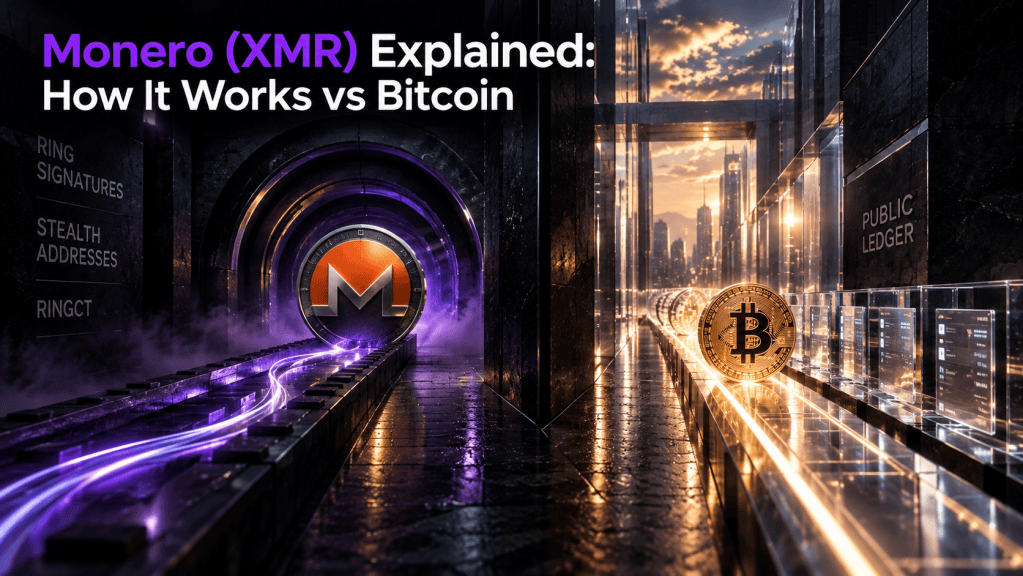
Monero is designed around fungibility, meaning that individual XMR units are intended to remain interchangeable regardless of their previous transaction history. Its blockchain does not publicly expose the sender, recipient, and transaction amount in the same way as Bitcoin. Instead, Monero uses privacy technologies such as ring signatures, stealth addresses, and RingCT to obscure key transaction details while still allowing the network to verify that transactions are valid.
This approach makes it significantly harder for an outside observer to connect a particular XMR payment with specific addresses or trace the movement of individual coins through the public ledger. As a result, XMR units are harder to distinguish based on their previous transaction history. However, transaction privacy does not mean that users are completely anonymous in every circumstance. Information obtained outside the blockchain, such as exchange records, IP data, or user-provided identifying information, can still create links between activity and a real-world identity.
How Monero Achieves Privacy by Default
Monero relies on three main technologies to protect transaction information:
- Ring signatures hide the real sender among a group of possible signers. The current ring size is 16, including 15 decoys.
- Stealth addresses create a unique destination for each transaction, making it harder to connect payments to a recipient.
- RingCT hides transaction amounts while allowing the network to verify that transactions are valid.
This does not mean that Monero protects every piece of information about a user. KYC records, compromised devices, exposed wallet credentials or information voluntarily given to another party can still reveal someone’s identity or activity.
Monero vs Bitcoin: Key Technical Differences
A Bitcoin vs Monero comparison for 2026 shows that the networks share Proof of Work but differ significantly in privacy, mining and monetary policy.
| Feature | Monero (XMR) | Bitcoin (BTC) |
|---|---|---|
| Consensus | Proof of Work | Proof of Work |
| Mining algorithm | RandomX | SHA-256 |
| Target block time | 2 minutes | About 10 minutes |
| Transaction privacy | Private by default | Public blockchain |
| Supply model | Tail emission | 21 million BTC maximum |
| Block capacity | Dynamic | Block weight limit |
Block Time and Network Speed
Monero’s target block time is 120 seconds, or 2 minutes, while Bitcoin targets approximately 600 seconds, or 10 minutes. The shorter interval on the Monero network means blocks are produced more frequently on average, although actual block times can vary because block production is probabilistic. These figures describe the networks’ target block intervals rather than a guaranteed transaction processing time.
It is also important to distinguish block production from transaction finality. A transaction being included in a newly mined block does not automatically mean that it should be treated as irreversible in every situation. Users and services may wait for additional network confirmation or follow their own transaction-handling policies before considering a payment sufficiently settled. Therefore, Monero’s 2-minute target should not be interpreted as a promise that every XMR transaction will be fully confirmed within exactly two minutes.
Mining and Network Hashrate
Monero uses RandomX, a Proof of Work algorithm designed to favor general-purpose CPUs and reduce the advantage of specialized ASIC hardware. Bitcoin uses SHA-256 and has a mining ecosystem built largely around ASICs.
Monero’s network hashrate, measured in GH/s, is a changing metric rather than a fixed protocol parameter. It depends on the amount of computing power participating in mining.
Supply Model: Tail Emission vs Fixed Cap
Bitcoin has a maximum supply of 21 million BTC. Monero does not have a fixed maximum supply. After its main emission, the network continues with tail emission of 0.6 XMR per 2-minute block. The resulting inflation rate declines over time as the total supply grows.
Exchanging Bitcoin for Monero
Bitcoin holders can exchange BTC for XMR through a supported exchange or swap service, depending on the options available in their jurisdiction. The amount of XMR received is determined by several factors, including the current exchange rate, BTC and XMR network conditions, applicable transaction fees, and the terms of the service being used. Because cryptocurrency rates can change while an exchange is being processed, the final amount may differ slightly from an initial estimate.
Swapter provides an exchange BTC-to-XMR option for users who want to convert BTC into XMR. According to Swapter’s website, users can select BTC as the asset they are sending and XMR as the asset they want to receive, enter the desired amount, provide a valid XMR receiving wallet address, and complete the exchange without creating a traditional account. Before confirming the transaction, users should carefully check the receiving address and the exchange details displayed by the service.
The exchange process still involves normal blockchain considerations. The BTC transaction must be broadcast and processed on the Bitcoin network, while the resulting XMR is sent to the specified Monero address. Network conditions and transaction processing times can therefore affect how quickly the exchange is completed. Applicable KYC or AML requirements can also depend on the transaction, service, jurisdiction, and other relevant circumstances, so users should review the requirements presented during the exchange.
Users who are new to XMR should also prepare a compatible Monero wallet before starting the exchange. The receiving address needs to support XMR, and the wallet should be controlled by the user or otherwise trusted by them. Readers who want a broader overview can see our how to buy Monero guide, which explains the purchase process in more detail and also covers options for storing XMR after the exchange.
What Affects Monero’s Price
XMR’s price is influenced by a combination of supply and demand, market liquidity, network activity, mining economics, exchange availability, and broader crypto-market sentiment. Demand can increase when users seek Monero’s privacy features, while market-wide sell-offs can put pressure on XMR even when activity on the Monero network remains stable. Liquidity also matters because markets with lower trading volume can experience larger price movements when substantial orders enter or leave the market.
Monero’s supply model is another factor to consider. Unlike Bitcoin, Monero does not have a fixed maximum supply, as its tail emission provides ongoing block rewards for miners. This creates a different supply dynamic that can affect how investors evaluate XMR over the long term. Exchange availability, regulatory developments, changes in mining profitability, and overall demand for privacy-focused cryptocurrencies can also influence market sentiment and price expectations.
Regulation can also affect access to XMR. In Europe, MiCA establishes a regulatory framework for crypto-assets and crypto-asset service providers, while the availability of specific assets and services can depend on the applicable rules and the provider’s policies. ESMA maintains a central MiCA register covering crypto-asset white papers, authorised crypto-asset service providers and non-compliant entities.
The EU MiCA transitional period ended on 1 July 2026, though some member states, including Germany and Ireland, closed their transitional windows earlier, by the end of 2025. Since then, unauthorised crypto-asset service providers can no longer offer covered services to EU clients under the previous transitional arrangements.
FAQ
Is Monero more private than Bitcoin?
Can Monero transactions be traced?
Why does Monero have no fixed supply cap?
Is Monero legal?
How is Monero different from Zcash?

Sign up for our newsletter
Join our newsletter and stay tuned with the latest insights.
