Menu
- How it Works
- Partners
- Support
- Blog
- About
- Contact Us
Change Language:
Transaction ID
Swap Tracker
Features
October 8, 2026
Litecoin (LTC) Explained: What Is It and How It Differs from Bitcoin
Contents
Litecoin emerged in the wake of the young and rapidly gaining popularity Bitcoin. This happened in 2011, when entrepreneur Charlie Lee took the existing cryptocurrency model as a basis. These two cryptocurrencies have undeniable similarities between cryptocurrencies: digital form, blockchain, accessibility, cryptographic type protection.
Their networks do not behave in exactly the same way, though. Litecoin aims to produce blocks more frequently, uses the Scrypt mining algorithm and has a maximum supply of 84 million LTC.
What Is Litecoin?
For people coming to Litecoin for the first time, the question of what Litecoin is has a fairly straightforward answer. It is a decentralized digital currency that allows users to transfer value directly through a blockchain. Litecoin does not depend on a bank or payment company to approve individual transactions.
The blockchain keeps a public history of Litecoin transactions. After a transfer enters a block and more blocks are added to the chain, altering that part of the record becomes progressively harder. The project was built using Bitcoin’s code as its foundation, although a number of technical parameters were changed. Litecoin targets a new block approximately every 2.5 minutes. Bitcoin’s target is around 10 minutes.
How Does Litecoin Work?
How Litecoin works can be understood by looking at how transactions are processed and recorded. All transactions between cryptocurrencies take place in a dedicated virtual wallet. A user with a dedicated access key logs into their account and gains access to their assets. Transactions are virtual and are carried out according to algorithms.
A valid transaction can remain pending until a miner includes it in a block. Miners take pending transactions and try to create a block that satisfies the proof-of-work requirements. Once one of them finds a valid result, the block is broadcast to other participants. They verify the proposed block before it becomes part of the blockchain.
Litecoin does not have a central company responsible for keeping its ledger. The blockchain serves as a shared record of transactions, while proof of work makes changing older entries increasingly difficult.
However, the operating algorithms used differ. Scrypt was part of Litecoin’s original design and was chosen partly to reduce the importance of specialized mining hardware.
What is Litecoin wallet technology actually responsible for? A wallet manages the private keys that allow a user to authorize transactions. The LTC itself remains recorded on the blockchain rather than being physically stored in the wallet.
E-wallets can be either online or offline. The only difference is the login method. Online wallets require a device, whether a smartphone or laptop, to be connected to the internet. Offline wallets store login keys in a special vault.
Litecoin vs Bitcoin: Key Differences
Without a doubt, Litecoin and Bitcoin are two cryptocurrencies with their own unique characteristics. There are several key categories to consider when comparing them:
- period of appearance;
- purpose of creation;
- principle of operation;
- functioning algorithm.
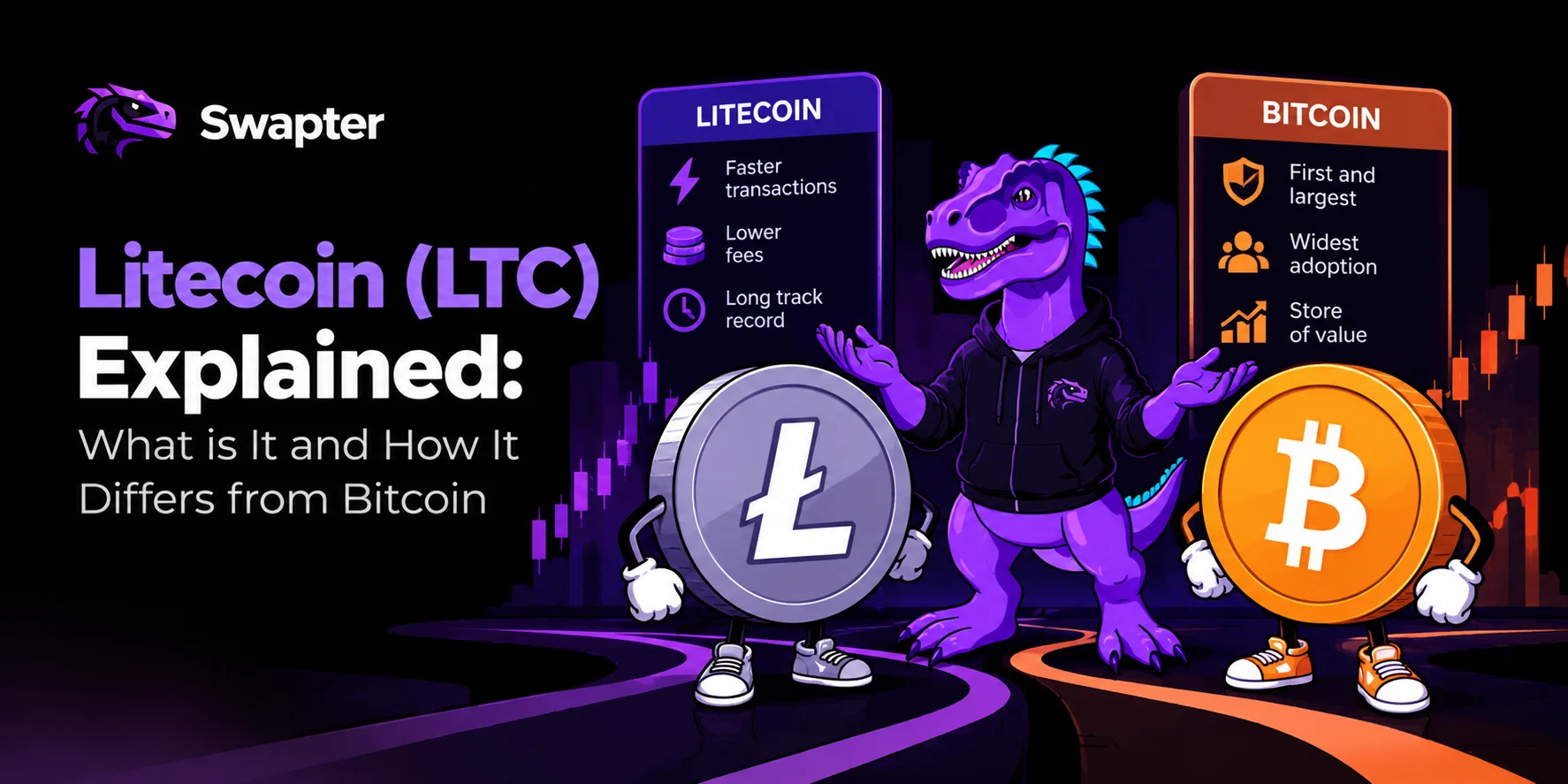
While Bitcoin is more widely accepted, Litecoin has faster block times and a higher total coin limit.
Transaction Speed
Litecoin transaction speed is one of the clearest areas to look at when comparing with Bitcoin. Litecoin aims for a new block about every 2.5 minutes. Bitcoin targets roughly 10 minutes. An LTC transaction can therefore receive its first block confirmation sooner on average.
A 2.5-minute block time should not be treated as a countdown. Litecoin does not produce a new block at exactly fixed intervals. Mining depends on probability, so a block may be found earlier than expected or take longer than usual. So the shorter Litecoin block interval gives LTC an advantage in terms of the average time between blocks, but it does not set a fixed confirmation time for every transaction.
Mining Algorithm
Comparing Litecoin vs Bitcoin can help explain the key differences between the two mining systems. The mining systems behind Litecoin and Bitcoin have the same basic purpose, but they use different algorithms. Bitcoin uses SHA-256. Litecoin uses Scrypt. The choice of Scrypt was part of Litecoin’s original design and helped establish a mining system that was distinct from Bitcoin’s.
Mining hardware has developed considerably since 2011. Specialized Scrypt ASICs are now available, meaning that serious Litecoin mining generally requires dedicated equipment rather than an ordinary computer.
A miner operating efficient hardware with inexpensive electricity may have very different economics from someone using comparable equipment in a region where power is expensive.
What Is Litecoin Used For?
Litecoin is also one of the payment options available online. The main requirement is to have a payment service that supports LTC. The process is as simple and straightforward as possible: the buyer sends the required amount from their digital wallet, and once the payment is confirmed, the transaction is added to the blockchain.
One of Litecoin’s main advantages is its short block generation interval. As a result, transactions are confirmed several times faster than with similar cryptocurrencies, such as Bitcoin. However, it is impossible to determine the exact processing time with certainty, as it can be affected by a wide range of external factors.
Another advantage of LTC is the convenience of storing it. The choice between cold wallet vs. hot wallet depends on how users plan to store and use their cryptocurrency. Users can keep their cryptocurrency in a digital wallet or make transactions between multiple wallets, exchanges, and other cryptocurrency platforms.
Extensive market experience is another important advantage. The cryptocurrency has been firmly established in the market for more than 15 years, experiencing both significant declines and periods of strong growth.
Although it is possible to analyze Litecoin’s entire development history, predicting its future is extremely difficult. It is impossible to know exactly how it will evolve in the years ahead. However, one thing is certain: the future of cryptocurrency depends largely on users who actively adopt and use it. As long as there is demand, the development of LTC is likely to continue.
Is Litecoin a Good Investment?
LTC can be a sensible investment. But it is not the right choice for everyone. You need to consider your savings goal, how much time you are willing to spend on it, and your own level. How far you are ready to go largely decides your success. Before you buy, it is worth thinking about a few important points.
| Factor | What to consider |
|---|---|
| Market position | How LTC compares with other cryptocurrencies |
| Network | Whether people are still using and developing it |
| Competition | Bitcoin and other coins used for payments |
| Litecoin mining profitability | Current costs and profitability |
| Liquidity | How easily LTC can be bought or sold |
| Risk | How much money you are comfortable losing |
There is no simple answer to whether Litecoin is a good investment. It may work for one investor and make little sense for another. Your budget and the amount of time you plan to hold LTC matter here.
The same goes for the question of whether Litecoin is better than Bitcoin. It really comes down to what someone wants to get from the cryptocurrency.
Bitcoin has a much larger presence in the market and a maximum supply of 21 million BTC. Litecoin can reach 84 million LTC, produces blocks at shorter intervals and uses a different mining algorithm.
How to Buy Litecoin
The question of how to buy Litecoin remains fairly simple to resolve. Getting some LTC is fairly easy. You first need an exchange or crypto service where Litecoin is available. Some providers ask for identity verification before you can make a purchase, while others may have different requirements.
Once you are logged in, look for LTC and choose how much you want to buy. Check the rate shown for the transaction and the fee before you confirm it. The final amount of Litecoin you receive will depend on these figures.
After the purchase, there are two simple options. You can leave the LTC on the exchange, or move it to a wallet that you control. If you choose to transfer the coins, check the address carefully and make sure it is meant for Litecoin. If you exchange BTC to LTC, take a moment to check the address and make sure the wallet supports LTC. A transfer sent to the wrong address usually cannot be undone.
FAQ
What is Litecoin used for?
Is Litecoin faster than Bitcoin?
How is Litecoin mined?
Can I store Litecoin in the same wallet as Bitcoin?
Is Litecoin still relevant in 2026?

Sign up for our newsletter
Join our newsletter and stay tuned with the latest insights.