Menu
- How it Works
- Partners
- Support
- Blog
- About
- Contact Us
Change Language:
Transaction ID
Swap Tracker
Tips
July 16, 2025
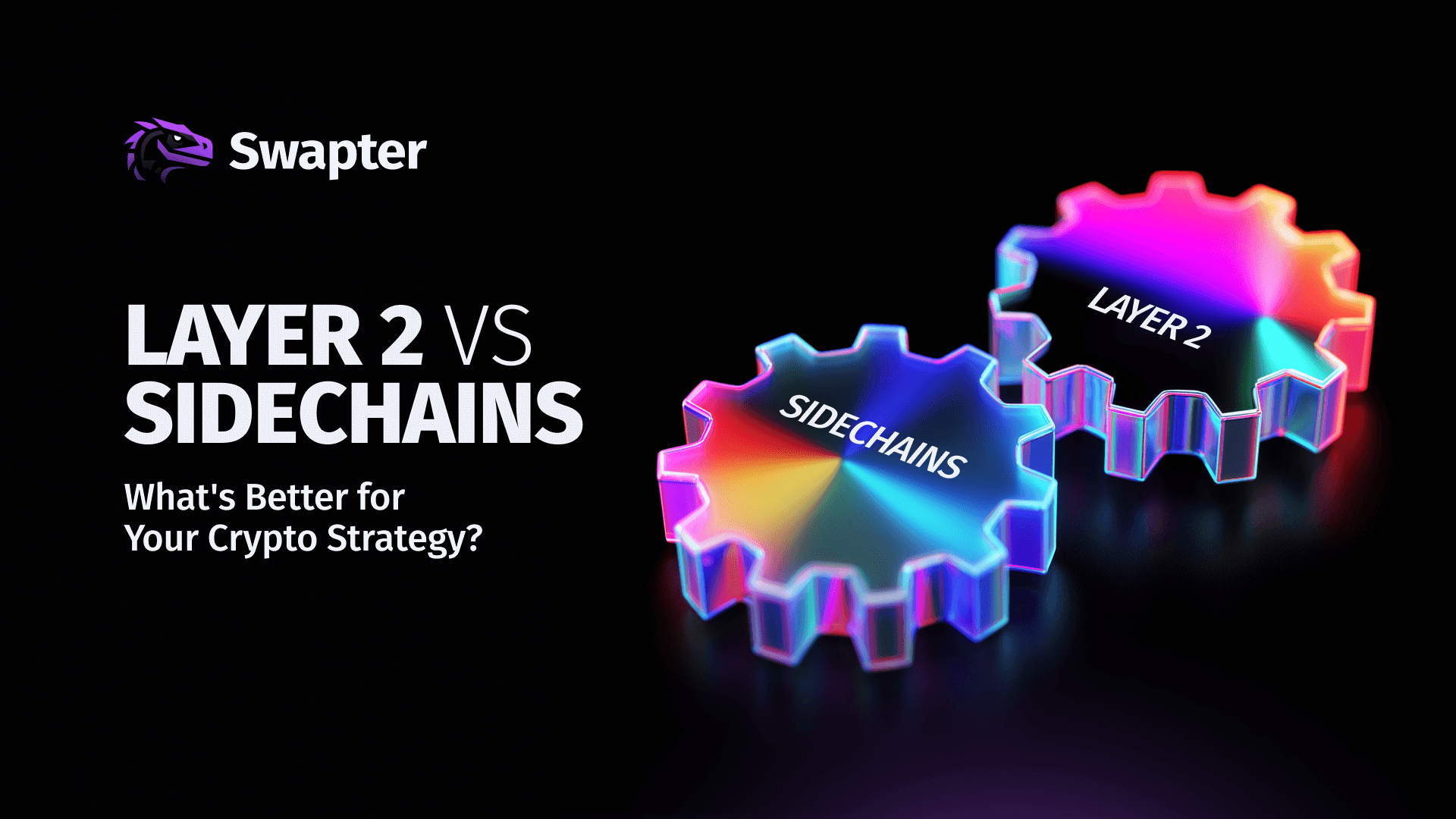
Layer 2 vs Sidechain — What’s the Difference and Which One Should You Choose?
Contents
As blockchain networks like Ethereum grow in popularity, they face significant challenges: limited throughput, high gas fees, and slow transaction speeds. To overcome these bottlenecks, two major scalability solutions have emerged — Layer 2 (L2) and Sidechains.
Both aim to scale the blockchain ecosystem, but they function in fundamentally different ways. This article breaks down:
-
What Layer 2 and Sidechains are
-
How they work
-
Key differences
-
When to use each
-
What the future holds
What is Layer 2?
Layer 2 refers to off-chain scaling solutions that process transactions outside the main blockchain (Layer 1), but still rely on it for final settlement and security.
Main Layer 2 technologies:
-
Rollups
-
Optimistic Rollups assume transactions are valid and only check if challenged (e.g., Arbitrum, Optimism).
-
ZK-Rollups use cryptographic proofs (zk-SNARKs/STARKs) to instantly validate transactions (e.g., zkSync, Starknet).
-
-
State Channels — allow multiple transactions between users off-chain, submitting only the final result to the main chain.
-
Plasma — creates child chains that periodically commit data back to Layer 1.
Key Benefits:
-
High scalability and low transaction costs
-
Inherited Ethereum-level security
-
Compatible with the broader Ethereum ecosystem
What is a Sidechain?
A Sidechain is an independent blockchain network that runs in parallel to Layer 1. It connects to the main chain via a two-way bridge but has its own consensus rules and validators.
Examples of Sidechains:
-
Polygon PoS
-
xDai
-
Ronin
-
Avalanche C‑Chain
Key Characteristics:
-
Customizable consensus mechanisms
-
Lower fees and higher throughput
-
Requires bridges to move assets across chains
|
Feature |
Layer 2 |
Sidechain |
|
Security |
Inherits from Layer 1 |
Independent, depends on own validators |
|
Dependency on L1 |
High — relies on Layer 1 |
Low — operates independently |
|
Scalability |
High, with Ethereum security |
Very high, with more control |
|
Flexibility |
Limited by L1 architecture |
Fully customizable |
|
Bridges Required |
No (usually native integration) |
Yes (two-way token bridges) |
|
Examples |
Arbitrum, zkSync |
Polygon PoS, xDai, Ronin |
Notable Layer 2 & Sidechain Projects
Layer 2:
-
Arbitrum
-
Optimism
-
zkSync
-
Starknet
Sidechain:
-
Polygon PoS
-
xDai
-
Ronin
Which One Should You Choose?
Choose Layer 2 if:
-
You require Ethereum-level security
-
Your app is DeFi-, NFT-, or dApp-oriented
-
Low fees and high throughput are essential
Choose a Sidechain if:
-
You need more control over consensus or fees
-
Your application is non-financial or gaming-focused
-
You can accept different trust assumptions
What’s Next?
As blockchain technology evolves, we see the rise of:
-
Layer 3: Custom app-specific networks built on top of L2s
-
Appchains: Dedicated blockchains for specific applications (e.g., in Cosmos)
-
Hybrid models: Combining rollups, Plasma, and Sidechains to achieve both security and flexibility
Conclusion
Layer 2 solutions provide scalability while maintaining the security of Ethereum.
Sidechains offer maximum customization, lower fees, and faster settlement times — ideal for gaming, private blockchains, and enterprise solutions.
At Swapter, we recommend:
-
Defining your security and performance needs
-
Evaluating user volume and costs
-
Testing with small deployments before scaling
Disclaimer:
This article is for informational purposes only. It does not constitute financial, investment, or technical advice. All actions based on this content are at the user’s own risk. Swapter and the authors are not liable for any losses resulting from its use.

Sign up for our newsletter
Join our newsletter and stay tuned with the latest insights.