Menu
- How it Works
- Partners
- Support
- Blog
- About
- Contact Us
Change Language:
Transaction ID
Swap Tracker
Tips
October 27, 2026
Circulating Supply vs Total Supply vs Max Supply: What’s the Difference?
Contents
Circulating supply, total supply, and max supply appear on almost every major cryptocurrency data page. At first glance, the three figures can look similar, but they describe different things. One shows the amount available in the market, another counts the coins or tokens that have already been created, and the third represents the maximum amount that can exist under the asset’s current rules.
Understanding the difference helps explain why two cryptocurrencies with the same price can have completely different market capitalizations. It also makes it easier to spot potential supply pressure when a large portion of an asset has not yet entered circulation.
Circulating Supply: What’s Actually Trading Right Now
What is circulating supply in crypto? It is the best available estimate of the coins or tokens that are currently circulating in the market and are generally available to the public. The exact methodology can vary between data providers because some holdings may be difficult to classify. Team allocations, locked tokens, strategic reserves, and other restricted holdings are often excluded from the reported figure.
The crypto circulating supply is especially important because it is commonly used to calculate market capitalization. The basic formula is: Market Cap = Price × Circulating Supply.
For example, if an asset trades at $2 and has a circulating supply of 100 million coins, its market capitalization is approximately $200 million. Using the total supply instead would give a different figure that may not represent the amount currently available to the public.
Circulating supply is not necessarily fixed. It can increase when newly issued coins enter the market or when previously locked tokens become available. It can also decrease when coins are permanently burned or become inaccessible. This is why the meaning of circulating supply is closely connected with actual market availability rather than the number of units that have ever been created.
Total Supply: Everything That Exists, Locked or Not
Total supply represents the amount of an asset that currently exists, generally after accounting for coins or tokens that have been verifiably burned. It can include assets that are already circulating as well as those held in locked contracts, reserves, treasury wallets, or other restricted accounts.
The difference between total and circulating supply can be substantial. A project may have created one billion tokens while only 300 million are considered circulating. The remaining 700 million may be subject to vesting, escrow arrangements, ecosystem allocations, or other restrictions.
This distinction is particularly useful when analyzing assets with scheduled releases. If a large share of the total supply is expected to enter the market later, future issuance can increase the amount available for trading and potentially create additional selling pressure.
XRP provides a clear example. XRP total supply is capped at 100 billion XRP, and all 100 billion were created from the beginning. Ripple placed 55 billion XRP into escrow arrangements to make the release schedule more predictable.
The comparison between XRP total supply and circulating supply therefore illustrates why the two figures can remain different for a long time. Coins can already exist as part of the total supply while remaining outside the amount classified as circulating.
Ethereum works differently because ETH does not have a fixed maximum supply. The gap between Ethereum’s circulating supply and total supply changes as new ETH is issued to validators and some ETH is burned through the EIP-1559 fee mechanism. As a result, Ethereum’s supply is dynamic rather than tied to a predetermined maximum number.
Max Supply: The Ceiling That May or May Not Exist
Max supply describes the maximum amount of an asset that can exist under its current protocol or token rules. For assets with a fixed cap, this figure provides a reference point for long-term issuance and potential scarcity.
Bitcoin is the best-known example. Its protocol is designed to create no more than 21 million BTC over time. XRP also has a fixed maximum of 100 billion XRP.
The XRP max supply is therefore very different from the maximum supply of an asset with ongoing issuance. Some networks and tokens have no fixed ceiling. Their supply can continue to increase according to rules governing validator rewards, staking incentives, governance decisions, or other forms of issuance.
It is also important to remember that a published maximum is not automatically an economic guarantee independent of the protocol. Some networks can change their monetary rules through governance or consensus changes. Therefore, max supply should be considered together with the mechanism that defines and enforces it.
A fixed maximum can support a scarcity-based monetary design. An uncapped model can instead prioritize ongoing issuance for network security, validator incentives, or ecosystem growth. Neither approach makes an asset valuable by itself.
Why These Three Numbers Rarely Match
The three supply figures describe different stages of an asset’s monetary lifecycle.
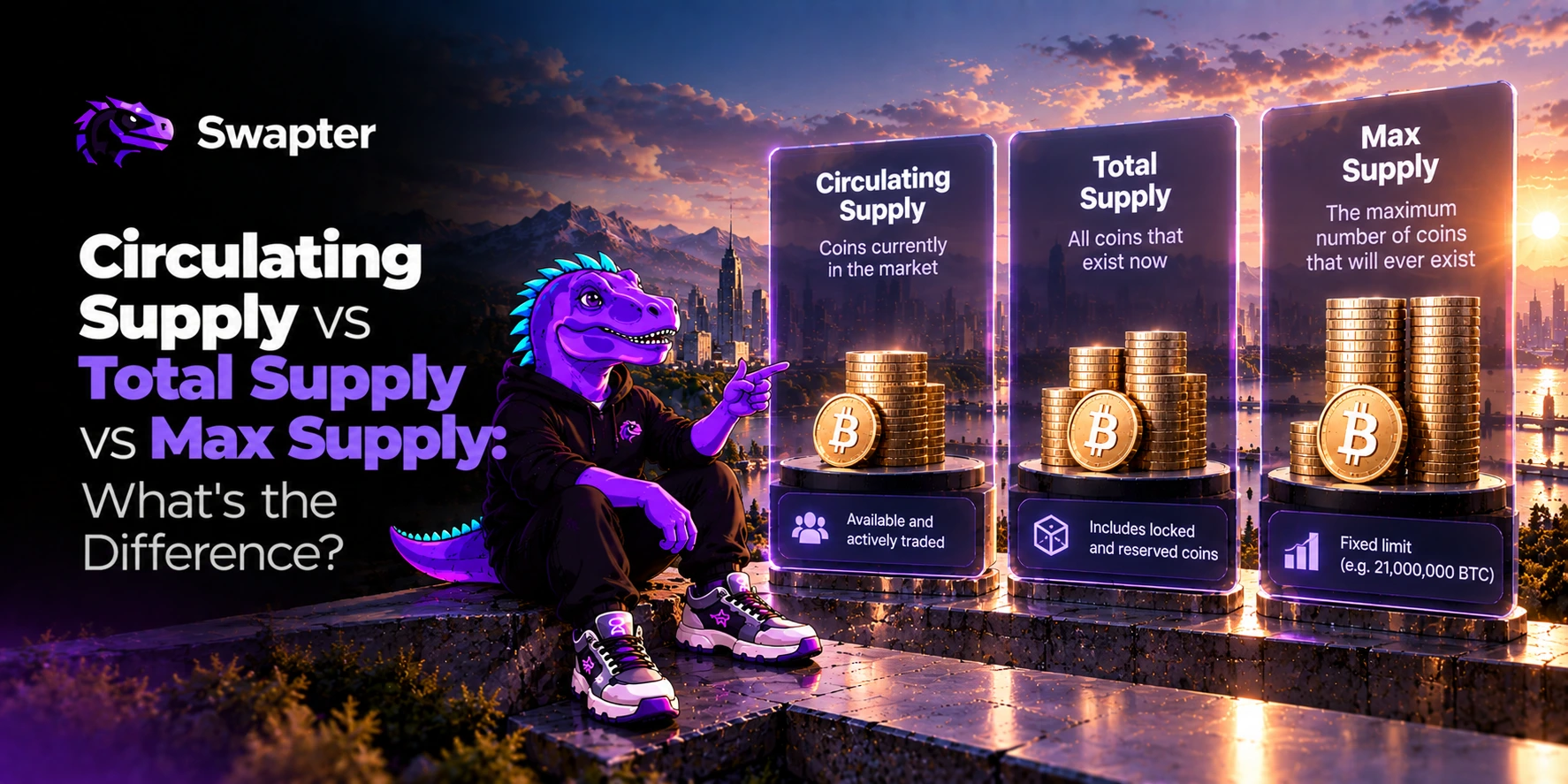
Circulating supply focuses on the portion generally available in the market. Total supply counts units that have already been created, including some that may still be restricted. Max supply represents the upper limit where such a limit exists.
The numbers can change for different reasons. New issuance can increase total supply and, when those units become available to the market, circulating supply as well. Token unlocks can increase circulating supply without creating new tokens because the assets were already included in total supply. Burns can reduce total supply and may also reduce circulating supply.
A simple comparison looks like this:
| Metric | What it counts | Can it change? | Main use |
|---|---|---|---|
| Circulating supply | Coins generally available in the market | Yes | Market-cap calculation |
| Total supply | Coins currently created, after verifiable burns | Yes | Understanding existing issuance |
| Max supply | Maximum amount allowed under current rules, if a limit exists | Usually fixed, depending on protocol rules | Assessing long-term issuance |
The gap between circulating and total supply can be especially important. A large difference may indicate that a significant amount of the existing supply remains locked or otherwise restricted. Investors therefore often check token release schedules alongside these figures rather than relying on a single number.
Coins With a Hard Cap vs Coins Without One
Bitcoin represents a hard-cap model. The network’s monetary rules limit the total number of BTC that can be created to 21 million. New BTC enter circulation through block rewards, and the issuance rate decreases over time according to the protocol.
XRP follows another fixed-supply model. All 100 billion XRP already exist, while escrow arrangements determine when part of that supply can be released.
Ethereum demonstrates the opposite approach. It does not have a fixed maximum supply. ETH is issued as validator rewards, while EIP-1559 burns part of transaction fees. Depending on network activity and issuance, the total supply can therefore grow or shrink over time.
These models serve different purposes. A fixed cap emphasizes predictable scarcity, while an uncapped or dynamically managed supply can provide more flexibility for network incentives and security.
Readers who want more background on Bitcoin can consult What Is Bitcoin. For a closer look at XRP and its monetary design, XRP Explained provides additional context.
Why This Actually Matters Before You Buy
Supply numbers matter because price alone tells you very little about the size of a cryptocurrency. An asset priced at $1 can have a much larger market capitalization than an asset priced at $100 if the first one has a much larger circulating supply.
Market capitalization is generally calculated using circulating supply, while fully diluted valuation uses the maximum supply when a reliable maximum figure exists:
Market Cap = Price × Circulating Supply
FDV = Price × Max Supply
The difference between these two figures can highlight how much supply has yet to enter circulation. For example, a token with 10 million units circulating out of a possible 100 million has a much larger potential supply expansion than one with 90 million units already circulating.
This does not mean that a large gap automatically makes an asset a bad investment. Unlocks may happen gradually, demand can grow, and some tokens may have specific utility within their ecosystems. The important point is that supply expansion should be considered when assessing valuation and future market pressure.
Checking circulating supply, total supply, max supply, and the token’s issuance or unlock schedule gives a more complete picture than looking at price alone. Supply figures do not determine whether an asset will rise or fall, but they help explain how its market value is distributed across the existing and potential future supply.
When an exchange is needed after making that assessment, Swapter lets users exchange supported crypto assets according to the service’s available functionality.
FAQ
Does circulating supply change over time?
Why do some coins have no max supply?
Is a lower max supply always better?
What happens when max supply is reached?
Can total supply decrease?

Sign up for our newsletter
Join our newsletter and stay tuned with the latest insights.
