Menu
- How it Works
- Partners
- Support
- Blog
- About
- Contact Us
Change Language:
Transaction ID
Swap Tracker
Tips
October 19, 2026
BNB (Binance Coin) Explained: What It Is and How It’s Used
Contents
BNB is the native token that keeps the BNB Chain ecosystem moving. It first appeared in 2017 under the name Binance Coin and was issued as an ERC-20 token on Ethereum. Later the project shifted it onto its own network. The same token now pays for transaction fees, supports staking, and appears in a variety of decentralized applications. People still call it Binance Coin in ordinary talk, yet the official designation is simply BNB.
From Exchange Token to Blockchain Asset
To understand what Binance Coin is, it helps to start with its original purpose: a utility token designed primarily for the Binance exchange and distributed through an initial coin offering in 2017. Holders could apply it toward lower trading fees on the platform. The company also ran periodic burns that permanently removed tokens from the circulating supply. Over the following years the function broadened.
A dedicated blockchain was introduced, the token migrated to the new infrastructure, and the broader ecosystem was later organized under the BNB Chain name. Today, BNB is used for network fees, staking arrangements, limited governance participation, and access to different services inside the ecosystem. The move from a narrow exchange discount token to a blockchain-native asset stands as one of the clearer transitions visible in the market.
BNB Smart Chain: The Network BNB Runs On
BNB Smart Chain is an EVM-compatible network that executes smart contracts and handles much of the activity inside the BNB ecosystem. Consensus follows a Proof-of-Staked-Authority (PoSA) model that relies on a comparatively small set of validators.
A series of upgrades has significantly reduced block times from the network’s original three-second range, while transaction costs remain relatively modest compared with many other networks. Developers continue to place applications on the chain partly for that reason. BNB is the token that must be spent to cover the gas fees attached to every transfer, swap, or contract interaction.
Important: Keep Native BNB for Network Fees
You need a sufficient balance of native BNB to pay network fees on BNB Smart Chain. This applies when sending BEP-20 tokens, swapping assets on a DEX, or interacting with smart contracts. Holding a BEP-20 token alone is not enough to pay the transaction fee.
Anyone who needs to convert holdings can exchange BNB to USDT through Swapter at a moment that suits their own schedule. The same low-cost environment also supports lending protocols, liquidity pools, NFT platforms, and other forms of on-chain activity that would carry higher expenses on alternative networks.
The Auto-Burn: Why BNB’s Supply Keeps Shrinking
The BNB auto-burn mechanism explained here consists of two concurrent processes that permanently remove tokens from circulation.
| Feature | Quarterly Auto-Burn | BEP-95 Real-Time Burn |
|---|---|---|
| Periodicity | Occurs quarterly | Operates continuously |
| Trigger / calculation | Uses a predefined formula based on BNB market data and network activity | Burns a portion of eligible gas fees generated on BNB Smart Chain |
| Source of burned BNB | BNB removed according to the quarterly calculation | A portion of gas fees collected by the network |
| Automation | Automated according to predefined rules | Automated as part of normal network operation |
The main Auto-Burn calculation is carried out once each quarter. A public formula determines the quantity to destroy, making the amount predictable from observable network data rather than from a private decision. The calculation takes into account the average price of BNB during the quarter and the number of blocks produced on BNB Smart Chain during the same period. A lower BNB price generally leads the formula to remove a larger amount, while a higher price leads to a smaller amount. This approach allows the quarterly burn to adjust to changes in market conditions and network activity while following a predefined mechanism.
The second process operates continuously under BEP-95. A portion of the gas fees collected in each block is burned automatically as part of the network’s normal operation. The amount removed through this mechanism therefore depends on activity on BNB Smart Chain rather than on a scheduled quarterly event. Together, the two processes create separate paths for reducing the token supply, with the quarterly Auto-Burn providing a periodic adjustment and the BEP-95 mechanism operating continuously as blocks are produced.
The two mechanisms work together to reduce the BNB supply toward the long-term target of 100 million BNB. Every burn is recorded on-chain and can be checked by any observer, providing a transparent record of the tokens removed from circulation. The Auto-Burn mechanism is independent of Binance’s centralized exchange activity and no longer bases the quarterly burn on the exchange’s reported earnings. This makes the current system more directly tied to predefined rules, BNB market data, and activity on the underlying network.
Where BNB Actually Gets Used
BNB token has several practical uses across the broader ecosystem.
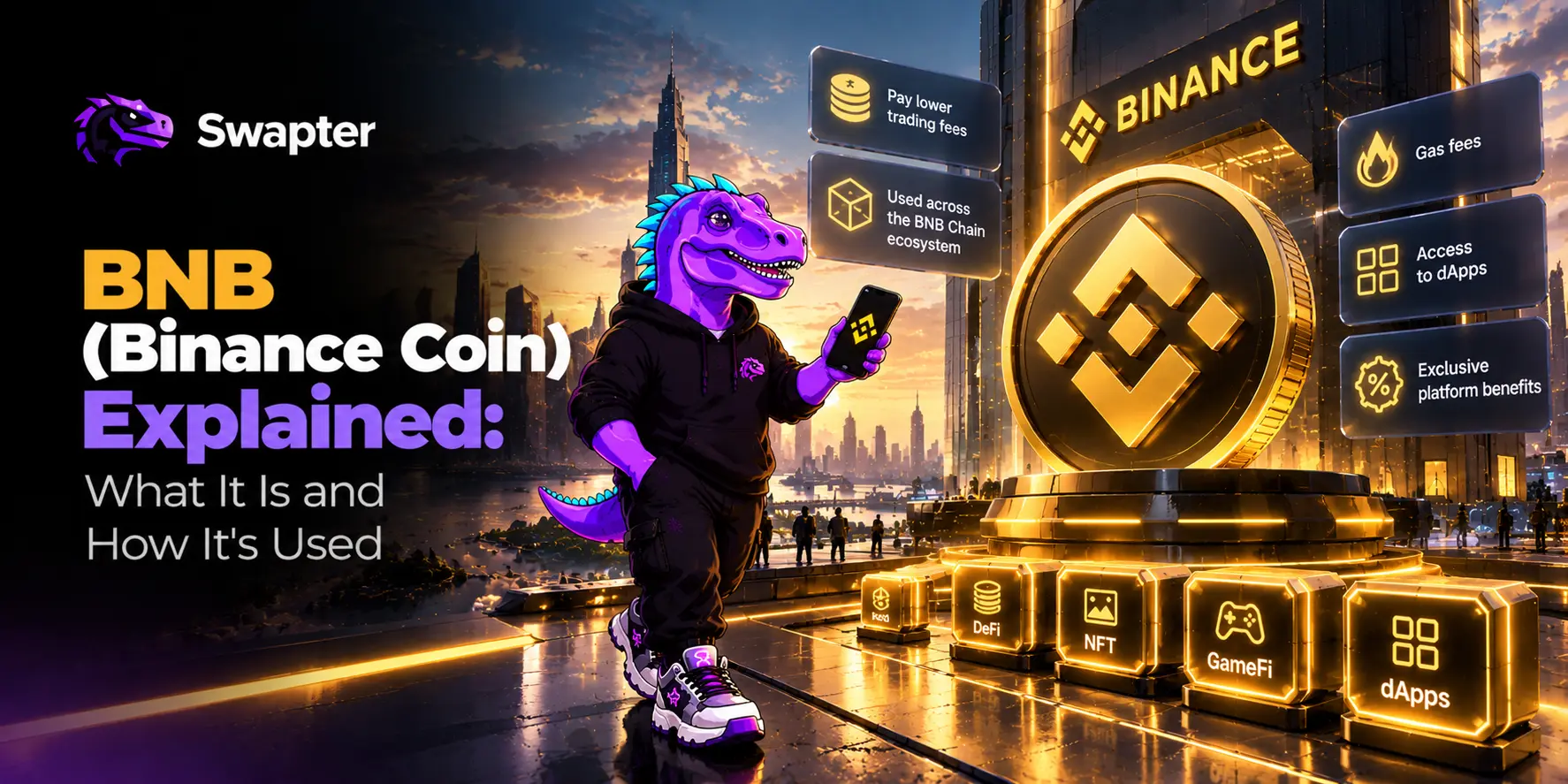
- Network gas fees. BNB is used to pay for transactions, token transfers, swaps, and smart contract interactions on BNB Smart Chain.
- Trading fee discounts. Users on the Binance exchange can use BNB to receive applicable trading-fee discounts.
- Liquidity and lending. BNB can be used in decentralized finance applications, including liquidity pools and lending protocols.
- Staking. BNB can be staked or delegated to validators under the applicable network mechanisms.
- Collateral and application-specific functions. Some decentralized applications use BNB as collateral or incorporate it into their own services.
These different use cases connect the centralized and decentralized parts of the BNB ecosystem. Demand can therefore come from several sources, including network activity, trading, and decentralized applications.
Weighing BNB as a Long-Term Hold
Whether BNB is a good investment depends on each person’s goals, investment horizon, and risk constraints. The token benefits from the steady contraction of supply produced by its burn mechanisms and from ongoing demand for gas on a network that processes large volumes of activity. Its utility across the broader BNB ecosystem can also support demand, as BNB is used for network fees, trading-related benefits, liquidity, lending, and other applications. At the same time, its outlook remains closely connected to the condition of the BNB Chain ecosystem and to the regulatory environment affecting major centralized exchanges.
Historical price action shows repeated periods of substantial gains followed by sharp declines, so past performance does not provide a reliable indication of future returns. Anyone assessing a possible position has to weigh the token’s deflationary features against the relatively concentrated validator set, competition from other smart-contract platforms, and the risks associated with broader crypto-market volatility. Changes in network usage can also influence demand, while shifts in regulation or exchange activity may affect sentiment around the asset.
Another factor to consider is portfolio concentration. Even if an investor has a positive view of BNB, allocating too much of a portfolio to a single crypto asset can increase exposure to market-specific risks. No isolated statistic, burn event, or historical price level settles the investment question. The decision ultimately depends on the investor’s time frame, tolerance for volatility, expectations for the BNB ecosystem, and the composition of the rest of the portfolio.
FAQ
Is BNB the same as Binance stock?
What blockchain does BNB run on?
Why does BNB get burned?
Is BNB centralized?
Can I stake BNB?

Sign up for our newsletter
Join our newsletter and stay tuned with the latest insights.
